
Propellantless electromagnetic propulsion for satellites — converts electrical energy directly into thrust, no fuel required. TRL 7-8 with 1,328 on-orbit hours across GEN-01/02/03 on SpaceX Transporter flights.
Genergo Propellant-Free Electromagnetic Propulsion System
Propellantless electromagnetic propulsion for satellites — converts electrical energy directly into thrust, no fuel required. TRL 7-8 with 1,328 on-orbit hours across GEN-01/02/03 on SpaceX Transporter flights.
Description
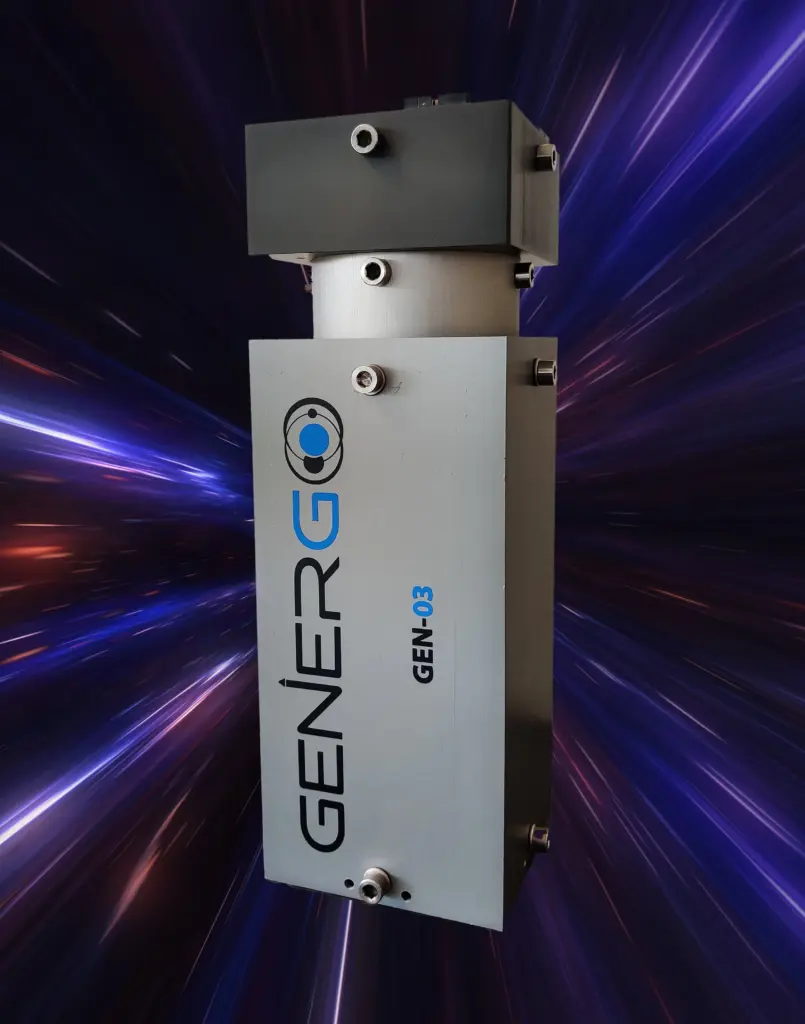
Genergo's propulsion system is the world's first propellantless electromagnetic space propulsion technology to be flight-tested and validated in orbit. The system generates thrust by converting electrical energy directly into controlled electromagnetic pulses — without propellant, without reaction mass expulsion, without pressurization components, and without hazardous materials. This architecture eliminates propellant tanks entirely, dramatically simplifying satellite bus design and enabling mission durations limited only by the spacecraft's power generation capacity and structural lifetime.
Three progressive flight units have been validated in orbit: GEN-01 (SpaceX Transporter-5, May 2022), GEN-02 (SpaceX Transporter-6, January 2023), and GEN-03 (SpaceX Transporter-9, November 2023), all hosted on D-Orbit ION Satellite Carrier platforms. Combined on-orbit heritage as of July 2026: 1,328 hours of operation across 1,538 activation cycles. Technology readiness level: 7-8.
The system is environmentally non-contaminating — critical for missions with optical payloads or tight proximity to other spacecraft. The technology is scalable, requiring only modest electrical power, and targets applications including station-keeping, controlled deorbit, and VLEO altitude maintenance. Genergo's technology is protected by a portfolio of granted international patents. The company is a Corporate Member of AIAA and is headquartered in Como, Italy.
Specifications
| Propellant required | None — propellantless electromagnetic system |
|---|---|
| Energy source | Electrical energy only |
| Pressurization hardware | None required |
| TRL | 7-8 |
| Gen-01 launch | 25 May 2022, SpaceX Transporter-5 (D-Orbit ION platform) |
| Gen-02 launch | 3 January 2023, SpaceX Transporter-6 (D-Orbit ION platform) |
| Gen-03 launch | 11 November 2023, SpaceX Transporter-9 (D-Orbit ION platform) |
| On-orbit operational hours | 1,328 hours (as of July 2026) |
| Activation cycles | 1,538 cycles |
| Applications | Station-keeping, deorbit, VLEO altitude maintenance |
| Patent protection | Granted international patent portfolio |