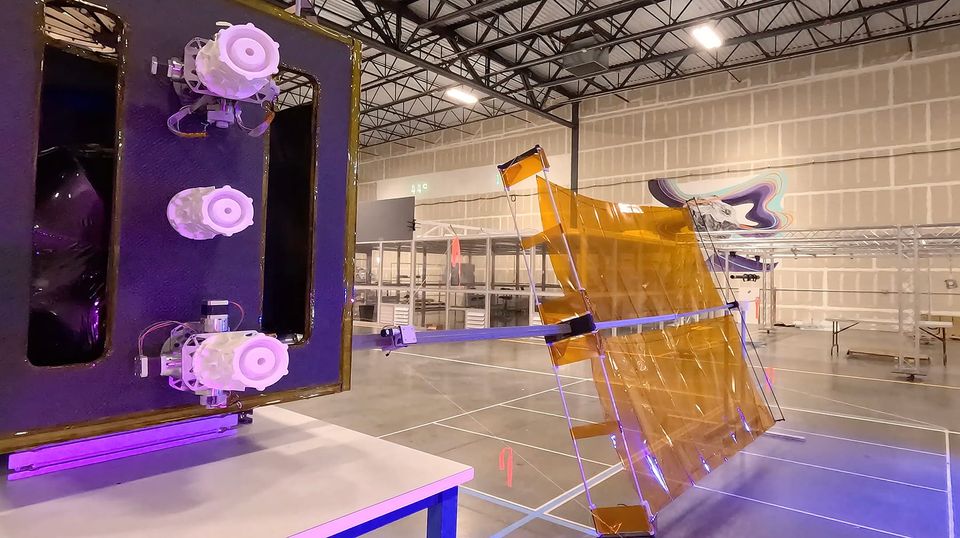

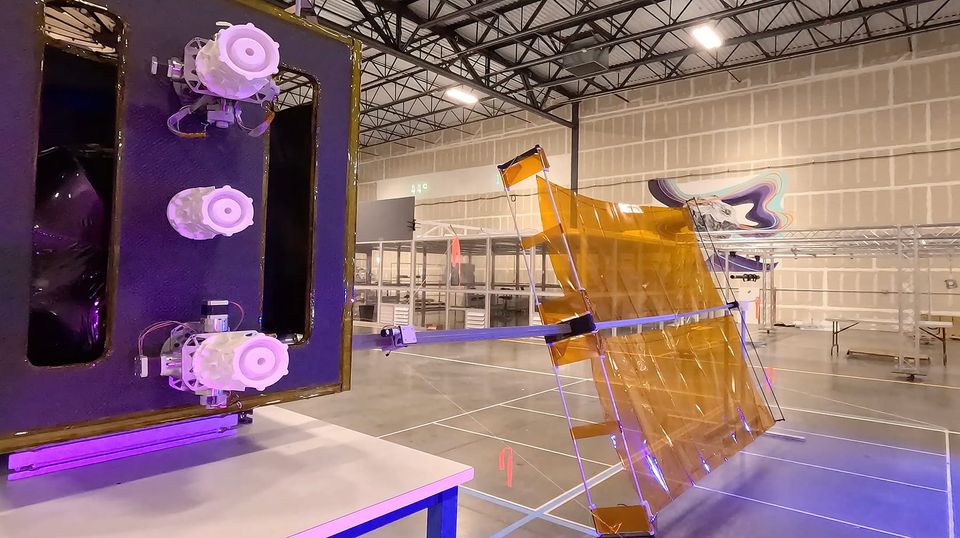
High Frontier — Deep Space Asteroid Mining Spacecraft
Description
High Frontier is Karman+'s first autonomous deep-space spacecraft, designed to travel from low Earth orbit to a near-Earth asteroid under its own electric propulsion, rendezvous and characterize the asteroid surface, and excavate kilogram-scale regolith samples to validate in-situ resource utilization (ISRU) technology in true zero-gravity. It is the first private asteroid mission built to a target cost below $10–15 million — roughly two orders of magnitude cheaper than NASA's OSIRIS-REx or JAXA's Hayabusa programs — by applying commercial off-the-shelf (COTS+) components and keeping approximately 80% of manufacturing in-house. The spacecraft is scheduled to ride as a secondary payload on SpaceX Transporter-19 (Q4 2026) to LEO, then autonomously spiral to its target asteroid using Hall-effect electric propulsion, with asteroid rendezvous planned for Q4 2027–Q1 2028. The primary science instrument is a Surface Dielectric Analyzer (SDA) developed with the University of Tokyo, measuring the dielectric constant of asteroid regolith — the same measurement used by the Artemis III Lunar Dielectric Analyzer. All mission data including asteroid science will be made freely available for independent research. The current primary target is near-Earth asteroid 99942 Apophis, with the flexible mission architecture supporting target switches if needed. High Frontier Mission 1 represents the foundational step toward Karman+'s long-term roadmap of commercial asteroid resource extraction to supply the in-space economy.
Specifications
| Mission type | Autonomous deep-space asteroid rendezvous and resource demonstration |
|---|---|
| Spacecraft class | Less than 1,000 kg |
| Propulsion | Hall-effect electric thruster |
| Navigation | Autonomous optical navigation for interplanetary transit and asteroid proximity ops |
| Primary target | 99942 Apophis (carbonaceous NEA) |
| Backup target | 2022 DC5 / 2021 UH2 |
| Launch vehicle | SpaceX Transporter-19 rideshare (secondary payload to LEO) |
| Launch date | Q4 2026 |
| Asteroid rendezvous | Q4 2027 – Q1 2028 |
| Mission cost envelope | $10–15 million total |
| Science payload | Surface Dielectric Analyzer (SDA) — University of Tokyo co-development |
| Sample goal | Kilogram-scale surface regolith excavation |
| Development approach | ~80% in-house; COTS+ off-the-shelf components space-qualified |
| TRL | Engineering model builds underway (as of 2026) |
| Data policy | All science data freely available for independent research |