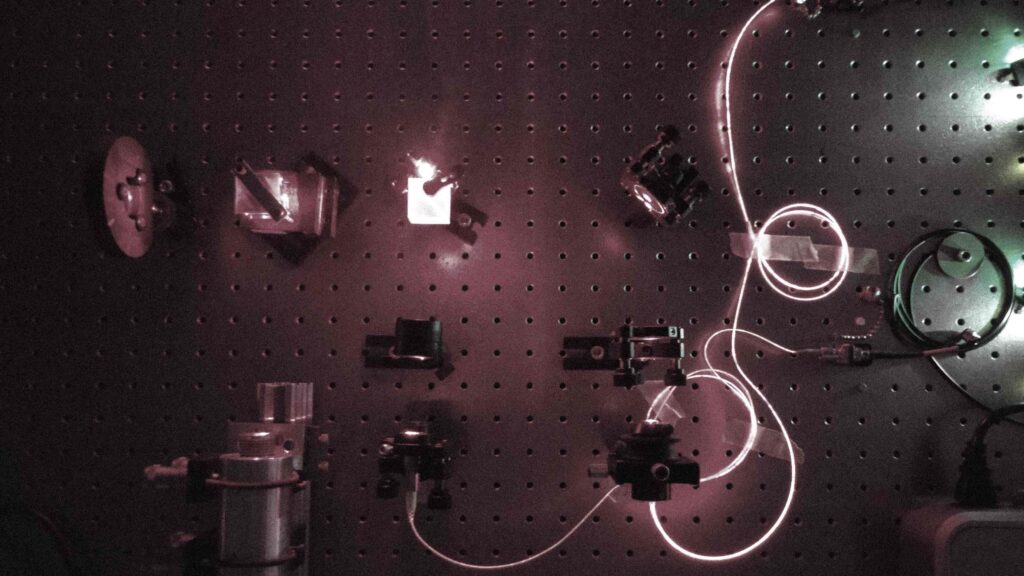


Free-space optical communication terminal that uses Orbital Angular Momentum (OAM) multiplexing and a patented multi-aperture receiver to multiply link capacity beyond conventional single-mode optical systems.
OAM Optical Communication Terminal
Free-space optical communication terminal that uses Orbital Angular Momentum (OAM) multiplexing and a patented multi-aperture receiver to multiply link capacity beyond conventional single-mode optical systems.
Description
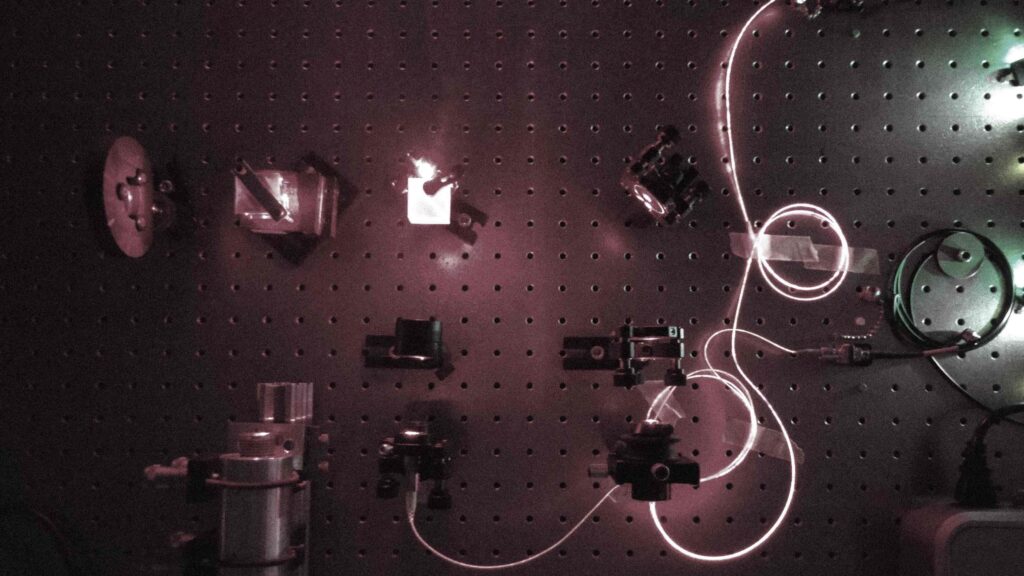
SatEnlight's OAM Optical Communication Terminal is a next-generation free-space optical communication system built around Orbital Angular Momentum (OAM) multiplexing. Conventional optical inter-satellite and space-to-ground links transmit information through a single spatial mode of light, forcing capacity growth to rely on spectral multiplexing and ever more complex, spectrum-hungry architectures. SatEnlight's terminal instead exploits OAM, an additional physical degree of freedom of light beyond wavelength and polarization, to encode multiple independent, co-propagating data streams on a single optical beam.
At the receive end, a patented multi-aperture receiver samples a localized region of the incoming structured wavefront, performs wavefront phase sensing, and demultiplexes the overlaid OAM channels in parallel, recovering each data stream independently. Because multiple channels share the same carrier and aperture, the terminal multiplies usable channel capacity without requiring additional spectrum allocation, while the mode-selective demultiplexing scheme also raises the intrinsic security of the link, since an eavesdropper lacking the matched receiver optics cannot cleanly separate the superimposed channels.
Free-space optical links are highly sensitive to atmospheric turbulence, which distorts the beam wavefront and degrades demodulation fidelity. SatEnlight integrates a turbulence mitigation module, supported by patent-pending electronics, that actively compensates atmospheric phase perturbations in real time. This reduces the complexity and cost required at the ground segment while maintaining reliable channel demodulation across a range of atmospheric conditions, making the terminal suitable for satellite-to-ground, inter-satellite, airborne and terrestrial free-space optical links.
The terminal targets satellite constellation operators, defense and airborne communications programs, and terrestrial free-space optical network operators who need to scale link capacity beyond what spectral multiplexing alone can deliver, while keeping ground infrastructure lean and links resilient to atmospheric disturbance.
Specifications
| Multiplexing technique | Orbital Angular Momentum (OAM) mode multiplexing |
|---|---|
| Receiver architecture | Patented multi-aperture receiver with parallel channel demultiplexing |
| Turbulence compensation | Integrated turbulence mitigation module (patent-pending electronics) |
| Target links | Satellite-to-ground, inter-satellite, airborne and terrestrial free-space optical |
| Key benefit | Capacity multiplication without additional spectrum; increased link security via mode-selective demultiplexing |