
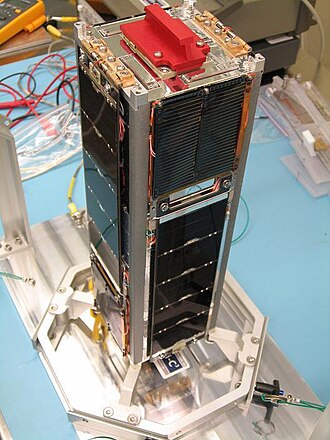
3U CubeSat and TU Delft's first satellite, the Netherlands' first nanosatellite, demonstrating thin-film solar cells and a battery-less power system.
Delfi-C3
3U CubeSat and TU Delft's first satellite, the Netherlands' first nanosatellite, demonstrating thin-film solar cells and a battery-less power system.
Description
Delfi-C3 is a triple-unit (3U) CubeSat developed by students and researchers at Delft University of Technology's Faculty of Aerospace Engineering. Launched on 28 April 2008, it was the first satellite built by TU Delft and the first nanosatellite launched by the Netherlands. Delfi-C3 demonstrated several novel technologies in orbit: thin-film solar cells, autonomous wireless sun sensors, a fully autonomous electrical power subsystem, and a radio amateur linear transponder. Notably, the satellite carried no batteries, with its experiments and subsystems operating directly on solar power. Delfi-C3 remained operational for more than 15 years, re-entering the atmosphere on 13 November 2023, and served as the foundation for TU Delft's ongoing Delfi-Space program, which went on to build follow-on nanosatellites including Delfi-n3Xt and Delfi-PQ.
Specifications
| Form factor | 3U CubeSat, 10 cm x 10 cm x 34 cm |
|---|---|
| Mass | 2.2 kg |
| Power | 2.4 W available, no onboard batteries (fully solar-dependent) |
| Orbit | Low Earth orbit (sun-synchronous, ~635 km) |
| Launch date | 28 April 2008, from Satish Dhawan Space Centre, India |
| Mission duration | Operational ~15.5 years; re-entered 13 November 2023 |