
Claim UCLA
Use your work email on the company domain (elfin.igpp.ucla.edu) — we will send you a confirmation link. Other emails are reviewed manually.
About UCLA
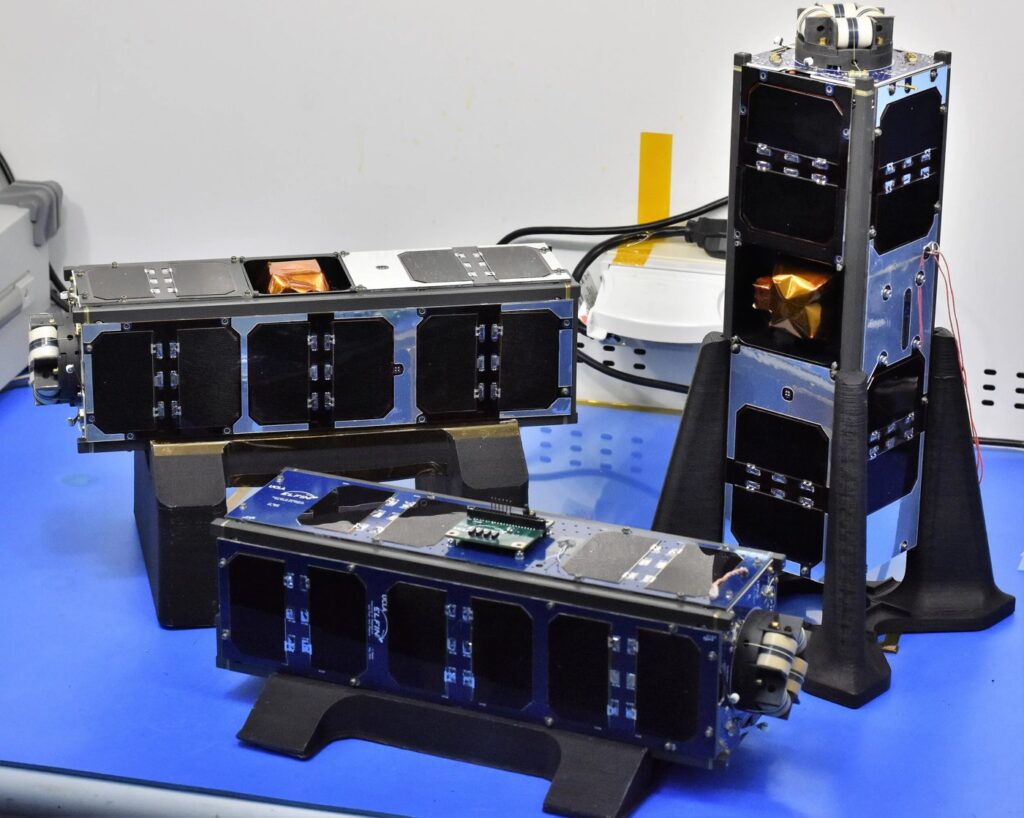
UCLA designed, built, tested, and operated the Electron Losses and Fields Investigation (ELFIN) twin satellite mission, which consists of two 3U+ CubeSats. The ELFIN mission studies space weather using three scientific instruments: a fluxgate magnetometer and two energetic particle detectors (one for electrons and one for ions). These instruments were developed in-house by UCLA staff members in the Earth, Planetary and Space Sciences department and the Institute for Geophysics and Planetary Physics. UCLA students were involved in all subsystems, including Attitude Determination and Control, Communication, Command and Data Handling, Flight Software, Payload, Power, and Structures, and constructed the majority of the final spacecraft in-house. Avionics and bus programming were also done by UCLA students, and structure fabrication occurred in an in-house machine shop. The ELFIN satellites were launched on September 15, 2018, and were active for just over 4 years, deorbiting in September 2022. The mission was funded jointly by the NSF and NASA CubeSat programs and was a participant in AFRL’s University Nanosatellite Program. The ELFIN mission is a collaboration with the Aerospace Corporation. UCLA staff have provided instruments on other satellites in the past, but ELFIN is the first entire spacecraft built, managed, and operated on the UCLA campus. As of 2018, over 250 students had passed through the project since its inception in 2009. The team currently consists of around 20 UCLA undergraduates leading mission operations and software development, with graduate students and staff members in mentorship roles.
Reviews
No reviews yet — reviews come from buyer accounts that have worked with this company.
Write a review