

3U CubeSat built by UT Austin's Texas Spacecraft Laboratory for GPS-based rendezvous and proximity-operations experiments as part of the LONESTAR program.
BEVO-2
3U CubeSat built by UT Austin's Texas Spacecraft Laboratory for GPS-based rendezvous and proximity-operations experiments as part of the LONESTAR program.
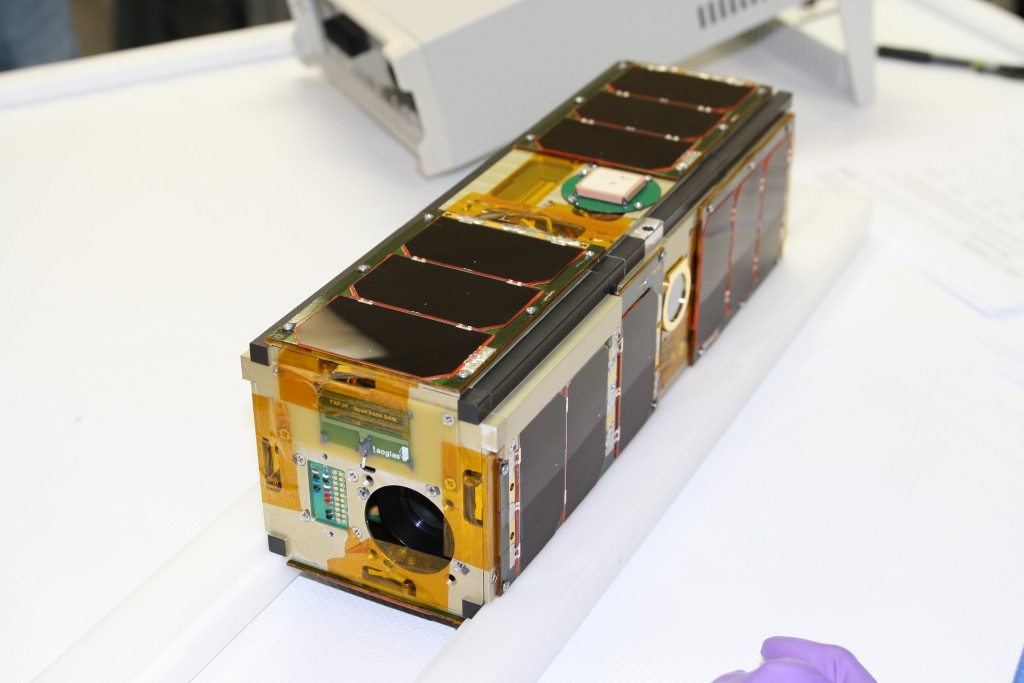
Description
BEVO-2 is a 3U CubeSat designed, built, and tested by more than 50 graduate and undergraduate students at the University of Texas at Austin's Texas Spacecraft Laboratory (TSL), part of the Cockrell School of Engineering's Department of Aerospace Engineering and Engineering Mechanics. It was developed as UT Austin's contribution to the LONESTAR (Low Earth Orbiting Navigation Experiment for Spacecraft Testing Autonomous Rendezvous) program, a collaboration between UT Austin, Texas A&M University, and NASA's Johnson Space Center, and successor to the earlier BEVO-1/DRAGONSAT-1 mission.
BEVO-2 was carried to the International Space Station stowed inside Texas A&M's ~50 kg AggieSat-4 nanosatellite. After AggieSat-4 was deployed from the ISS and had drifted a safe distance away, it released BEVO-2 to begin a planned autonomous rendezvous and proximity-operations demonstration. The two spacecraft were designed to cross-link communications, exchange GPS navigation data, and transmit telemetry to ground radio stations, testing relative navigation techniques applicable to future automated rendezvous and docking missions.
At 4.2 kg, BEVO-2 was relatively large and complex for a 3U CubeSat of its era, packing a GPS receiver, inter-satellite communications link, and attitude determination and control hardware into a compact bus. Although on-orbit software issues prevented full achievement of the proximity-operations objectives, brief communications were established with BEVO-2, and the mission provided extensive systems engineering, GPS navigation, and spacecraft operations experience for the TSL student team, feeding directly into UT Austin's subsequent CubeSat programs such as ARMADILLO.
Specifications
| Form factor | 3U CubeSat |
|---|---|
| Mass | 4.2 kg |
| Orbit | Low Earth orbit (deployed from ISS altitude, ~400 km) |
| Launch | Carried to ISS aboard SpaceX CRS mission; deployed from AggieSat-4 |
| Mission | GPS-based autonomous rendezvous and proximity operations (LONESTAR program) |
| Partners | Texas A&M University, NASA Johnson Space Center |