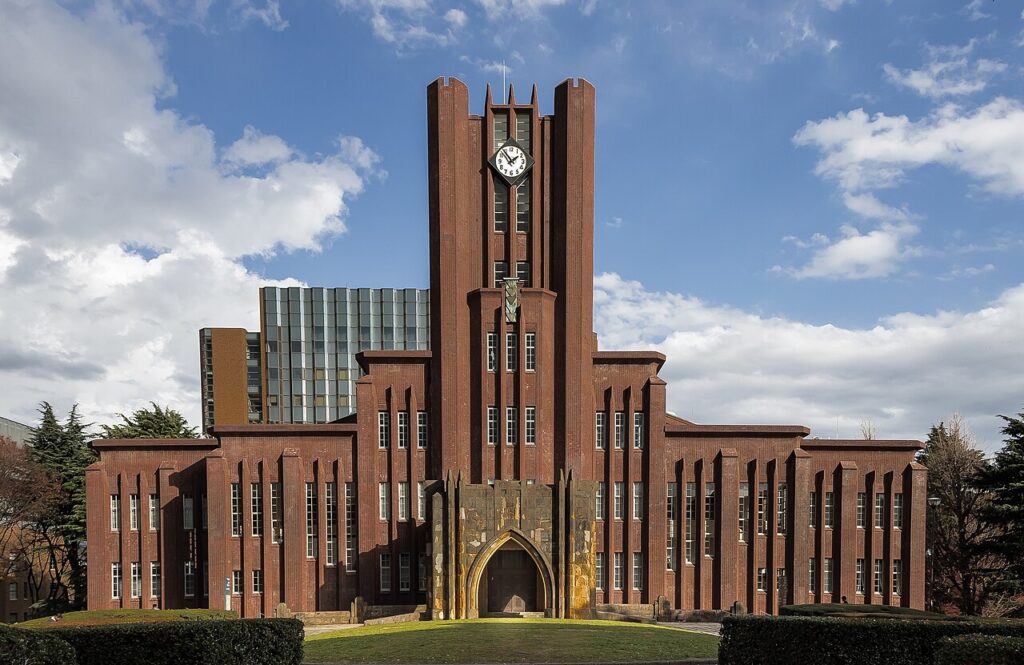

Claim University of Tokyo
Use your work email on the company domain (space.t.u-tokyo.ac.jp/missions) — we will send you a confirmation link. Other emails are reviewed manually.
About University of Tokyo
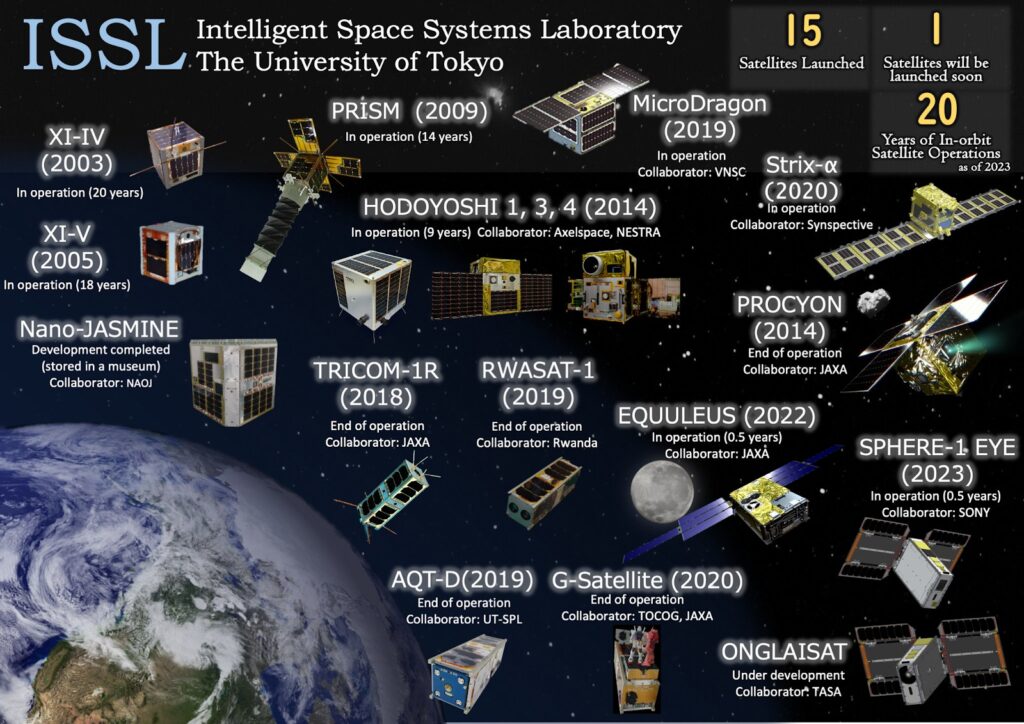
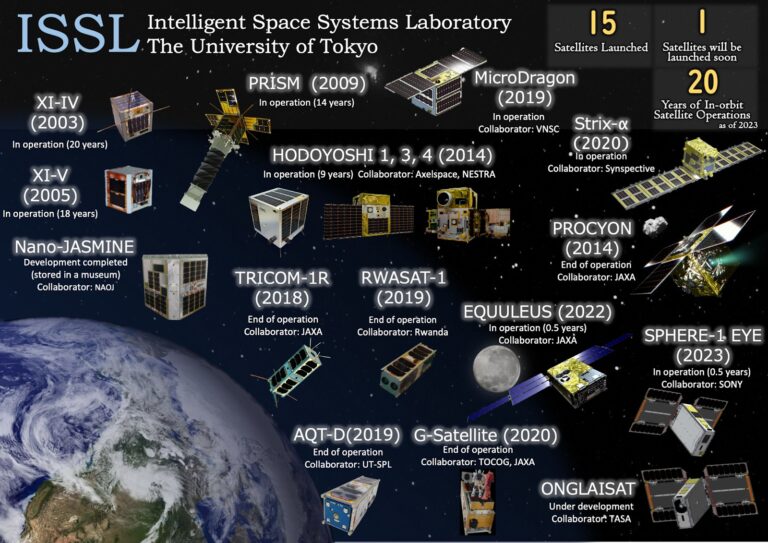
The University of Tokyo's Intelligent Space Systems Laboratory (ISSL), part of the Department of Aeronautics and Astronautics, is globally recognized as the birthplace of the CubeSat standard's first flight heritage. In 2003, ISSL developed and launched XI-IV, a 1 kg, 10 cm cube satellite, on a Russian Rockot from Plesetsk Cosmodrome on June 30, 2003. XI-IV became the world's first CubeSat to achieve successful on-orbit operation, proving that a functional satellite bus could be built almost entirely from low-cost commercial off-the-shelf components — a demonstration that helped catalyze the modern smallsat/CubeSat industry. XI-IV remained operational for over two decades, recognized as the longest-operating CubeSat in history.
Building on that success, ISSL launched XI-V in 2005, then PRISM in 2009, an 8.5 kg nanosatellite with a deployable 1-meter boom carrying a compact telescope for 30-meter-resolution Earth imagery. ISSL's program continued to scale with the Hodoyoshi series of low-cost microsatellites (2014), the deep-space probe PROCYON (launched alongside Hayabusa2, 2014), and MicroDragon and RWASAT-1, satellites built with Vietnam and Rwanda.
Most recently, ISSL developed EQUULEUS, a 6U CubeSat launched on NASA's Artemis I Space Launch System mission in November 2022 to demonstrate low-thrust trajectory control techniques in the Earth-Moon system and observe the plasmasphere. ISSL is widely credited as a founding institution of the global university-built smallsat movement, training generations of Japanese and international space engineers.
Milestones
- 1877 University of Tokyo founded
- 2003 XI-IV launched — world's first operational CubeSat
- 2022 EQUULEUS launched aboard NASA Artemis I
Photos 2
Additional Services
2
The University of Tokyo offers capacity-building programs designed to equip young researchers with essential skills in satellite design, manufacturing, and testing. This is achieved through practical involvement in the development, launch, and operation of satellites, such as the 50kg-class ultra-small…
The University of Tokyo offers satellite design and development services, drawing upon their extensive experience in creating CubeSats and 50kg-class satellites. They focus on developing versatile and high-performance bus systems, as demonstrated by their 6U bus system adopted in multiple…
Reviews
No reviews yet — reviews come from buyer accounts that have worked with this company.
Write a review