Agnibaan
 Agnikul Cosmos
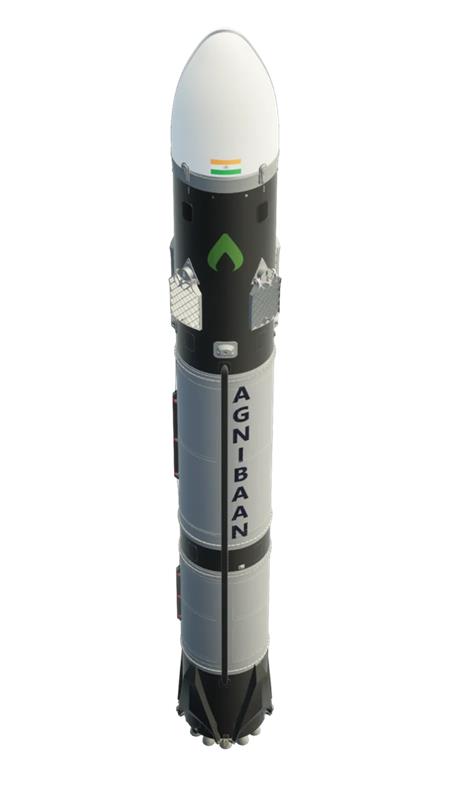
Agnibaan is Agnikul Cosmos' fully indigenous, customizable small-satellite launch vehicle powered by the world's first single-piece, fully 3D-printed semi-cryogenic engine, Agnilet.
Key figurescomparable across the catalogue
- Mass
- 14,000 kg
- Payload capacity
- 100 kg
Normalised to common units so this product can be compared with others in its category. The supplier's own wording is below.
As published by the supplier
- Height
- ~18 m
- Diameter
- 1.3 m
- Liftoff mass
- ~14,000 kg
- Stages
- 2, configurable, with optional 'baby stage' inside payload fairing
- Engine
- Agnilet - semi-cryogenic, LOX/kerosene, electric-pump-fed, single-piece fully 3D-printed, clusterable
- Engine thrust
- ~25 kN per Agnilet engine at sea level
- Specific impulse
- ~285 s (sea level), up to ~355 s (vacuum)
- Payload to LEO
- ~100 kg to 700 km orbit (baseline); configurable up to ~300 kg depending on configuration
- Launch site
- Dhanush mobile launch pad, Satish Dhawan Space Centre, Sriharikota
- Flight heritage
- Agnibaan SOrTeD suborbital demonstrator flight successfully launched 30 May 2024 - first flight of a rocket with a fully 3D-printed engine
About
Agnibaan is a small orbital-class launch vehicle developed by the Chennai-based, IIT Madras-incubated startup Agnikul Cosmos to deliver small satellites to low Earth orbit on demand. Its defining innovation is the Agnilet engine, a semi-cryogenic, liquid-oxygen/kerosene, electric-pump-fed engine whose entire combustion section is manufactured as a single 3D-printed piece. The vehicle uses a clusterable engine architecture that lets Agnikul reconfigure the number of first-stage engines to size the rocket precisely to a customer’s payload and orbit requirements. In its baseline two-stage configuration, Agnibaan stands roughly 18 meters tall with a 1.3 meter diameter and a liftoff mass around 14,000 kg. Agnikul first validated the propulsion and vehicle systems with Agnibaan SOrTeD, a single-stage suborbital variant, which flew successfully from the company’s own mobile launch pad (‘Dhanush’) at Satish Dhawan Space Centre, Sriharikota on 30 May 2024 — the first flight of a rocket powered by a fully 3D-printed engine and the first launch from a privately developed Indian launchpad.
Documentation
No public datasheet yet — request the datasheet / ICD from the supplier.