Vega-C
 Arianespace
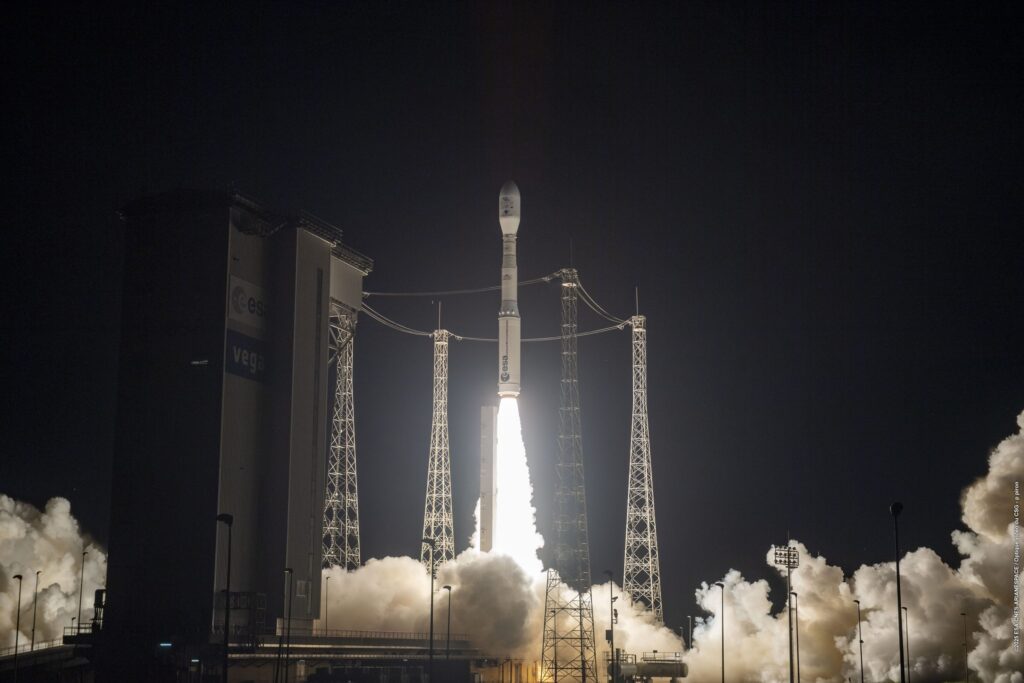
European small-lift launch vehicle for polar and sun-synchronous orbit payloads up to 2,350 kg.
Key figurescomparable across the catalogue
- Payload capacity
- 2,350 kg
Normalised to common units so this product can be compared with others in its category. The supplier's own wording is below.
As published by the supplier
- Payload to SSO (700 km)
- 2,350 kg
- Payload to SSO (300 km)
- ~3,300 kg
- First stage
- P120C solid motor (shared with Ariane 6)
- Second stage
- Zefiro-40 solid motor
- Fairing diameter
- 3.3 m
- Height
- ~35 m
- Launch site
- Guiana Space Centre, Kourou, French Guiana
- First flight
- July 2022
About
Vega-C is the enhanced evolution of the Vega launch vehicle family, developed by Avio for ESA and operated by Arianespace. It targets small satellite and institutional payloads to polar and sun-synchronous orbits (SSO), representing the European small-lift launch capability alongside the heavier Ariane 6.
Compared to the original Vega, Vega-C features an upgraded first stage (P120C — the same motor as Ariane 6’s strap-on boosters, providing commonality), a new second stage (Zefiro-40), and an improved payload fairing (3.3 m versus 2.6 m diameter) to accommodate larger payloads. These improvements raised the vehicle’s payload capacity to SSO from 1,500 kg (Vega) to approximately 2,350 kg.
Vega-C’s maiden flight occurred in July 2022 and successfully placed Earth observation satellites into SSO. Its second mission (VV22) in December 2022 failed due to a manufacturing defect in the Zefiro-40 nozzle, and flights were suspended. Arianespace and Avio resumed flights after a qualification campaign, with the vehicle returning to service in 2024.
Vega-C carries Arianespace’s small satellite customers, including ESA Earth observation missions (Sentinel series), and also offers a dedicated rideshare configuration via the Small Spacecraft Mission Service (SSMS) dispenser for multiple smallsats.
Documentation
No public datasheet yet — request the datasheet / ICD from the supplier.