Astranis Omega
 Astranis Space Technologies
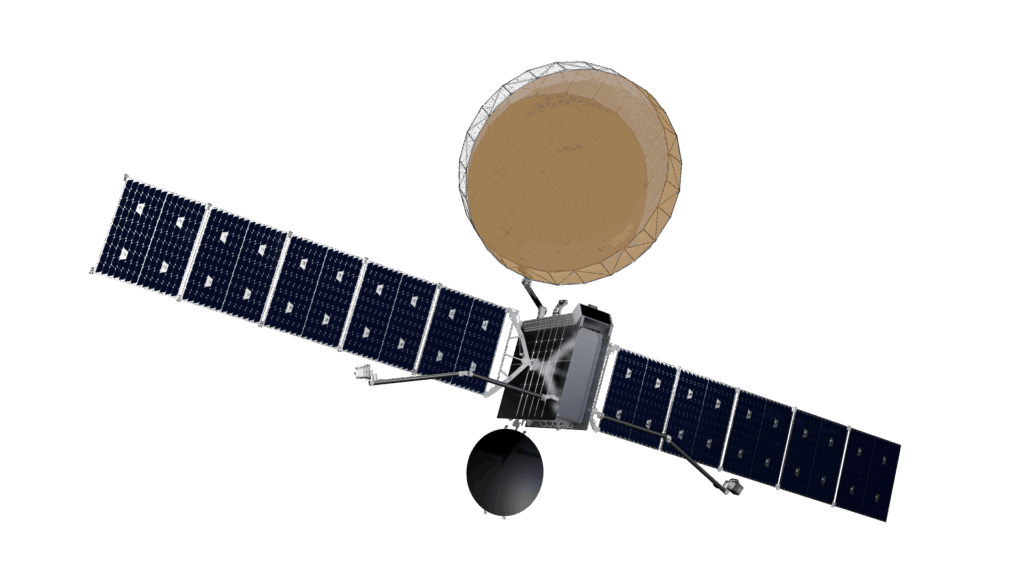
Omega is Astranis's next-generation MicroGEO satellite delivering over 50 Gbps of Ka-band broadband — approximately five times the throughput of the original MicroGEO — in a 650 kg package for commercial and military applications.
Key figurescomparable across the catalogue
- Mass
- 650 kg
- Data rate
- 50,000 Mbps
- Design life
- 10 years
Normalised to common units so this product can be compared with others in its category. The supplier's own wording is below.
As published by the supplier
- Satellite class
- MicroGEO (next-generation)
- Orbit
- Geostationary (GEO)
- Mass (wet)
- 650 kg
- Stowed dimensions
- 2.0 m × 2.1 m × 1.2 m
- Throughput
- >50 Gbps
- Frequency bands (Payload)
- Ka-band, Military Ka-band, X-band
- Frequency bands (Feeder)
- Q/V-band
- Military waveform support
- Protected Tactical Waveform (PTW)
- Propulsion
- All-electric
- Design life
- 10 years
- In-house manufacturing
- ~70% of components
- Planned production rate
- Up to 24 satellites/year
- First customer launch
- 2026
About
Astranis Omega is the company’s second-generation MicroGEO satellite platform, unveiled in April 2024 as a significant performance leap over the original Prime satellite. Omega delivers over 50 Gbps of total throughput, representing roughly a four-to-five times improvement over the first-generation MicroGEO, while maintaining the small-satellite philosophy that makes Astranis competitive on cost. It achieves this through a much larger deployable antenna reflector that concentrates signal power and a larger solar array driving more capable solid-state power amplifiers.
Omega has a wet mass of 650 kg and stows to dimensions of 2m × 2.1m × 1.2m for launch. It transmits in Ka-band for civilian customers and additionally supports Military Ka-band and X-band for government and defense users. The software-defined radio payload supports advanced military waveforms including the U.S. Department of Defense’s Protected Tactical Waveform (PTW), and Astranis has secured a contract from Space Systems Command to integrate military communication capabilities into Omega satellites.
The all-electric propulsion system enables station-keeping and multi-mission relocation over the satellite’s 10-year operational lifespan. Customer launches are planned starting 2026, with a prototype satellite targeting 2025. Astranis plans to scale production to 24 Omega satellites annually. Approximately 70% of satellite components are manufactured in-house.
Documentation
No public datasheet yet — request the datasheet / ICD from the supplier.