AubieSat-1
 Auburn University
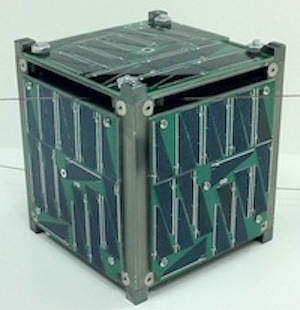
1U CubeSat built by Auburn University undergraduates, launched in 2011 as an amateur radio and ionospheric research satellite.
Technical specifications
- Form factor
- 1U CubeSat
- Dimensions
- 10 x 10 x 10 cm
- Mass
- 1.03 kg
- Orbit
- Sun-synchronous LEO (~800 km)
- Launch date
- 28 October 2011
- Launch vehicle
- Delta II (Vandenberg AFB)
- Mission
- Amateur radio, ionospheric Faraday rotation, solar panel material testing
About
AubieSat-1 (radio callsign AubieSat-OSCAR 71) was the first satellite designed, built, and tested by Auburn University, developed almost entirely by undergraduate students in the Auburn University Small Satellite Program (AUSSP). It launched on October 28, 2011 aboard a Delta II rocket from Vandenberg Air Force Base, California, as part of NASA’s Educational Launch of Nanosatellites (ELaNa) initiative, riding alongside the primary NPP mission.
The 1U CubeSat, measuring 10 x 10 x 10 cm and weighing roughly 1.03 kg, carried out two primary science objectives: testing the on-orbit durability of two different solar panel encapsulation materials against radiation and thermal cycling degradation, and measuring average ionospheric electron density along the line of sight to ground stations using the Faraday rotation effect on its transmitted radio signal. AubieSat-1 also operated as an amateur radio satellite, broadcasting telemetry, battery voltage data, and the Auburn University ‘War Eagle’ battle cry in Morse code to ham radio operators worldwide.
The mission gave Auburn engineering and physics undergraduates end-to-end experience in spacecraft design, integration, environmental testing, and mission operations, establishing the foundation for Auburn’s ongoing small satellite program and subsequent CubeSat missions.
Documentation
No public datasheet yet — request the datasheet / ICD from the supplier.