Long March 5
 CASC — China Aerospace Science and Technology Corporation
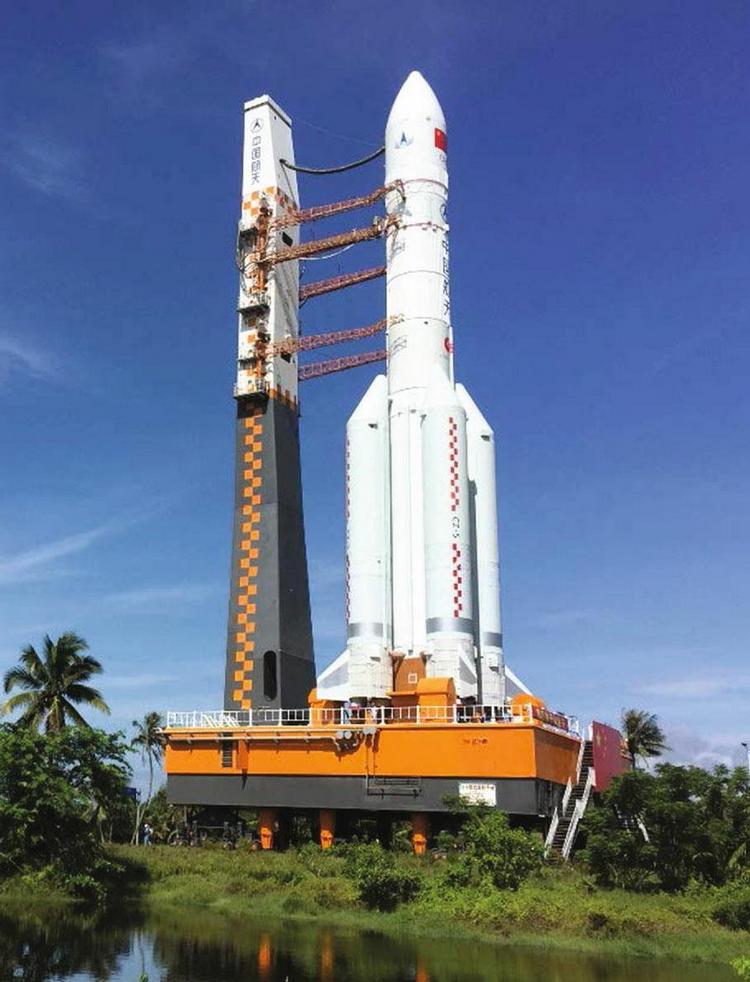
China's most powerful rocket, capable of 25,000 kg to LEO — used for space station modules, lunar exploration, and Mars missions.
Key figurescomparable across the catalogue
- Payload capacity
- 25,000 kg
Normalised to common units so this product can be compared with others in its category. The supplier's own wording is below.
As published by the supplier
- Payload to LEO
- 25,000 kg
- Payload to GTO
- 14,000 kg
- Core stage propellants
- LOX/LH2
- Boosters propellants
- LOX/Kerosene (4× YF-100)
- Liftoff thrust
- ~1,000 tonnes
- Launch site
- Wenchang Space Launch Center, Hainan
About
Long March 5 (CZ-5) is China’s heavy-lift launch vehicle and its most powerful rocket in operational service. The two-stage vehicle uses liquid oxygen/kerosene on its two outer strap-on boosters and liquid oxygen/liquid hydrogen on its core stage and upper stage, producing approximately 1,000 tonnes of thrust at liftoff. It can deliver up to 25,000 kg to LEO or 14,000 kg to GTO.
Long March 5 has been used for China’s most ambitious space programs: the Chang’e 5 lunar sample return mission (2020), the Tianwen-1 Mars orbiter and rover (2020), the Tianhe core module of the Chinese Space Station (2021), and subsequent CSS modules and Xuntian Space Telescope mission. Its performance fills the role occupied by the Space Launch System (NASA) and Ariane 5 (ESA) in the Western launch market — enabling large GEO communications satellites, space station logistics, and deep space exploration.
Long March 5 launches from the Wenchang Space Launch Center in Hainan province, China’s southernmost launch site, chosen for its equatorial proximity to reduce the delta-v required for GTO missions.
Documentation
No public datasheet yet — request the datasheet / ICD from the supplier.