HiakaSat
 University of Hawai'i at Manoa
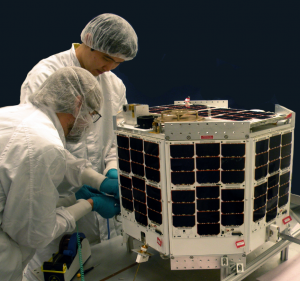
55 kg micro-satellite built by the Hawaii Space Flight Laboratory for hyperspectral remote sensing, flown on the ORS-4 mission.
Key figurescomparable across the catalogue
- Mass
- 55 kg
Normalised to common units so this product can be compared with others in its category. The supplier's own wording is below.
As published by the supplier
- Mass
- 55 kg
- Class
- Micro-satellite
- Launch date
- 3 November 2015 (Super Strypi / SPARK rocket)
- Launch site
- Pacific Missile Range Facility, Kauai, Hawaii
- Primary payload
- Space Ultra-Compact Hyperspectral Imager (SUCHI), long-wave infrared
- Mission
- Operationally Responsive Space-4 (ORS-4)
About
HiakaSat is a 55-kilogram micro-satellite developed by the University of Hawaii at Manoa’s Hawaii Space Flight Laboratory (HSFL) for remote sensing technology demonstration. Its name derives from the Hawaiian goddess associated with storytelling and doubles as an acronym for Hyperspectral Imaging, Aeronautical Kinematic Analysis. HiakaSat carried the DARPA-funded Space Ultra-Compact Hyperspectral Imager (SUCHI), a long-wave infrared hyperspectral imaging payload developed at UH, alongside two color Earth-observation cameras and an additional community-college-built sensor payload. More than 130 students took part in the satellite’s design, fabrication, and testing. HiakaSat flew as the primary payload on the Operationally Responsive Space-4 (ORS-4) mission, launched 3 November 2015 on a Super Strypi (SPARK) rocket from the Pacific Missile Range Facility on Kauai — the first orbital launch attempt from Hawaii. The launch vehicle failed to reach orbit, but the mission met HSFL’s core goals of building Hawaii’s satellite design, launch, and operations workforce.
Documentation
No public datasheet yet — request the datasheet / ICD from the supplier.