ARGO 1.0 Star Tracker
 Hipparcos S.r.l.
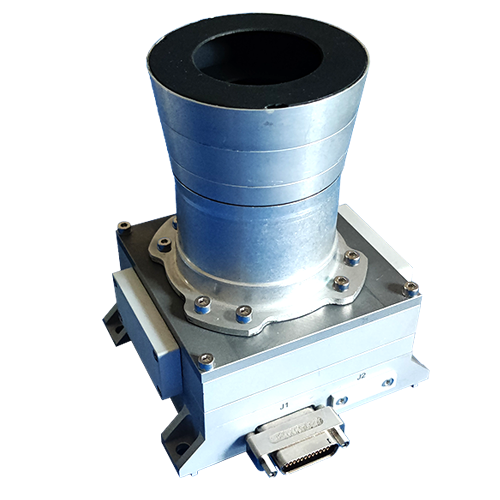
Flight-proven multicamera autonomous attitude determination system (star tracker) for small satellites.
Typed specifications61 values
Discloses 9 of 12 fields engineers filter by in this category (category median 8).
- Accuracy, cross-boresight
- 15 arcsec 3 sigma, NEA (BRF) - EOL - @1°/s, 1 OH (XY) · datasheet p.2 9 arcsec 3 sigma, NEA (BRF) - EOL - @1°/s, 2 OH (XYZ) | 6 arcsec 3 sigma, NEA (BRF) - EOL - @1°/s, 3 OH (XYZ) | 15 arcsec NEA (3σ) (BRF) - EOL - @1°/s, 1 OH (XY) | 9 arcsec NEA (3σ) (BRF) - EOL - @1°/s, 2 OH (XYZ) +10
- Mass
- 385 g Camera · datasheet p.2 355 g RPCU
- Accuracy, about boresight (roll)
- 9 arcsec NEA, 3σ, 2 OH (XYZ), BRF, EOL, @1°/s · datasheet p.2 6 arcsec NEA, 3σ, 3 OH (XYZ), BRF, EOL, @1°/s | 2 arcsec Systematic Error, 2 OH (XYZ), BRF, EOL, @1°/s | 1 arcsec Systematic Error, 3 OH (XYZ), BRF, EOL, @1°/s
- Envelope (L×W×H)
- 73 x 91 x h79 Camera, incl. mounting feet · datasheet p.2 106 x 91 x h39 RPCU, incl. mounting feet
- Update rate
- 10 Hz datasheet p.2
- Max tracking rate
- 10 °/s Max tracking rate, 1 OH · datasheet p.2 10 °/s Max tracking rate, 2 OH | 10 °/s Max tracking rate, 3 OH | 10 °/s max · Max tracking rate, 1/2/3 OH
- Field of view
- 22.4 ° datasheet p.2 22.4 ° ± 11,2° (full angle = 2 × half-angle per field definition) | 22.4 ° ± 11,2° implies a total FOV of 22.4 degrees
- Lost-in-space acquisition time
- 3 s <, from Lost in Space (up to 3°/s) · datasheet p.2 3 s max · from Lost in Space (up to 3°/s) | 3 s max · from Lost in Space (up to 3°/s), <3s
- Supply voltage
- 9 V min · datasheet p.2 60 V max
- Power consumption
- 2.7 W Camera · datasheet p.2 2.7 W Camera (2,7 W) | 1.1 W RPCU | 1.1 W RPCU (1,1 W)
- Data interface
- RPCU vs Spacecraft datasheet p.2 Spacewire RPCU vs Spacecraft | RPCU vs Spacecraft | RS-422 RPCU vs Spacecraft | RPCU vs Spacecraft +1
- Operating temperature
- -30 °C min · datasheet p.2 60 °C max
- Radiation tolerance (TID)
- 30 krad Optical assembly · datasheet p.2
- Design lifetime
- 5 years in LEO · datasheet p.2
- Configuration
- multi-head (2+ optical heads) from 1 camera (monocamera) up to 5 cameras (multicamera); RPC… · datasheet p.1 single unit monocamera version (smart camera with integrated processing)
- Survival temperature
- -40 °C min · datasheet p.2 70 °C max
- Random vibration
- 17.38 g RMS Random vibration levels · datasheet p.2 17.38 g RMS random, 17,38 g RMS
- Flight heritage
- since 2021 datasheet p.1
- Missions flown
- 2 021 Flight heritage · datasheet p.1
- Quasi-static load
- 17.38 g Vibration levels (random) · datasheet p.2
- Detector
- CMOS datasheet p.2
- Angular rate output
- yes Output @ 10 Hz: attitude (quaternion), angular speed, angular… · datasheet p.1
Each value is typed with its unit and measurement condition and cites the datasheet page it was taken from. Nothing is guessed: a field that is absent here has not been published by the manufacturer. machine-extracted ✓ checked by NewSpace Market ✓ manufacturer confirmed by the manufacturer.
As published by the supplier13 lines, in the manufacturer's own wording
- Interface
- RS422, SpaceWire, CANBus (redundant)
- Flight heritage
- In-orbit demonstration on D-Orbit ION SCV2, launched Jan 2021, validated through Jul 2022
- TRL
- 8 (flight-demonstrated)
- Validated functions
- Pattern recognition, tracking-mode accuracy, straylight robustness, Moon/Earth-in-FOV handling, in-orbit calibration
- Field of view
- ± 11,2°
- Frequency
- 10 Hz
- Accuracy
- 1 arcsec (Systematic Error, 3 OH), 6 arcsec (NEA, 3σ, 3 OH)
- Mass
- 385 g (Camera), 355 g (RPCU)
- Dimensions
- 73 x 91 x h79 mm (Camera), 106 x 91 x h39 mm (RPCU)
- Supply voltage
- 9-60 V
- Power
- 2,7 W (Camera), 1,1 W (RPCU)
- Operating temperature
- -30°C to 60° C
- Lifetime
- 5 years in LEO
About
ARGO 1.0 is Hipparcos’ multicamera Autonomous Attitude Determination System (AADS), designed to let a small satellite autonomously determine its attitude, angular rate, acceleration and the derivative of acceleration using onboard star-pattern recognition, without dependence on external references such as GNSS. The system uses a proprietary multi-camera architecture with integrated image processing electronics, built on more than three decades of heritage from parent company EICAS Automazione’s work on ESA’s original Hipparcos astrometry mission and the SAC-C and AST/MHS2 spacecraft programs.
ARGO 1.0 reached TRL8 through an in-orbit demonstration (IOD) campaign on D-Orbit’s ION SCV2 orbital platform, launched 24 January 2021 and operated through July 2022. The IOD validated star pattern recognition, tracking-mode accuracy, robustness to straylight, correct behaviour with the Moon and Earth in the field of view, and in-orbit calibration routines. The unit supports RS422, SpaceWire and redundant CANBus interfaces for integration with spacecraft avionics.
Documentation
Need the full ICD, test reports or a specific revision? Ask the supplier directly.