QEYSSat Microsatellite
 QEYSSat (Quantum Encryption and Science Satellite)
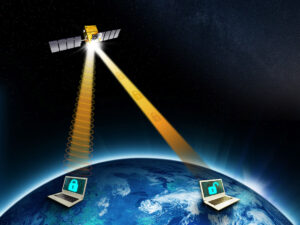
Canadian Space Agency quantum key distribution microsatellite in LEO, built by Honeywell (formerly COM DEV Canada) to demonstrate secure ground-to-space quantum communication.
Technical specifications
- Mission type
- Technology demonstration (QKD)
- Orbit
- Low Earth Orbit (LEO), ~600 km altitude
- Platform
- Microsatellite
- Primary payload
- Quantum receiver with 25 cm telescope aperture
- QKD protocol
- Prepare-and-measure (uplink); BB84 and variants
- Photon sources
- Weak coherent pulse (WCP) and entangled photon source (EPS)
- Mission duration
- 1 year (extendable to 2 years)
- Prime contractor
- Honeywell Aerospace, Cambridge, Ontario
- Contract value
- CAD $30 million
- Science lead
- University of Waterloo Institute for Quantum Computing
- Primary ground station
- CSA, Saint-Hubert, Quebec
- Launch
- No earlier than late 2026
About
The QEYSSat microsatellite is the primary flight element of the Canadian Space Agency’s Quantum EncrYption and Science Satellite mission. Built by Honeywell Aerospace in Cambridge, Ontario (formerly COM DEV Canada) under a CAD $30 million contract awarded in June 2019, the spacecraft performs Quantum Key Distribution (QKD) from low Earth orbit at approximately 600 km altitude.
The satellite carries a quantum receiver payload featuring a 25 cm aperture telescope that collects individual photons transmitted upward from optical quantum ground stations. Photons are generated at the ground stations using weak coherent pulse (WCP) or entangled photon source (EPS) sources developed by the National Research Council of Canada and the University of Waterloo’s Institute for Quantum Computing. The quantum channel operates in the free-space optical band, using the satellite’s acquisition, pointing, and tracking (APT) system to maintain the precise alignment required.
The mission also carries a secondary optical communications payload on the opposite side of the spacecraft. Ground stations include the primary Optical Quantum Ground Station at CSA headquarters in Saint-Hubert, Quebec, and a secondary station at the University of Waterloo’s Research Advancement Centre. The mission has a nominal duration of one year, extendable to two years. Launch is anticipated no earlier than late 2026.
Documentation
No public datasheet yet — request the datasheet / ICD from the supplier.