Pulsed Plasma Rocket (PPR)
 Howe Industries
NASA NIAC-funded nuclear pulsed-plasma propulsion concept aiming to cut crewed Mars transit time to about two months — 100,000 N thrust, 5,000 s specific impulse, 282 MW power.
Typed specifications4 values
Discloses 3 of 10 fields engineers filter by in this category (category median 3).
- Mass
- 80 000 kg product page
- Thrust
- 100 000 000 mN product page
- Specific impulse
- 5 000 s product page
- Power consumption
- 282 W product page
Each value is typed with its unit and measurement condition and cites the datasheet page it was taken from. Nothing is guessed: a field that is absent here has not been published by the manufacturer. machine-extracted ✓ checked by NewSpace Market ✓ manufacturer confirmed by the manufacturer.
As published by the supplier9 lines, in the manufacturer's own wording
- Thrust
- 100,000 N (100 kN)
- Specific impulse
- 5,000 s
- Reactor power
- 282 MW
- Spacecraft total mass
- 80,000 kg
- Payload capacity
- 18,500 kg
- Delta-v
- 45.5 km/s
- Crewed mars transit time
- ~2 months
- Propellant type
- Pulsed fission-fusion plasma
- Program status
- NASA NIAC Phase II (selected 2024)
About
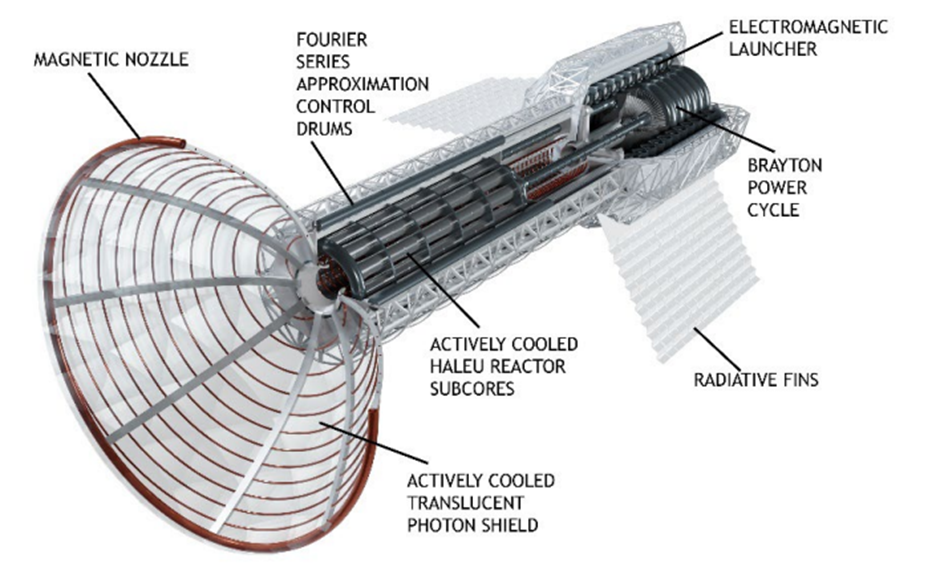
The Pulsed Plasma Rocket (PPR) is derived from Howe Industries earlier Pulsed Fission-Fusion (PuFF) concept, using a modified z-pinch device to compress a fission-fusion fuel target inside a liquid lithium sheath, producing high-velocity plasma exhaust for thrust. It combines high thrust with high specific impulse, a combination NASA notes is not otherwise available in current propulsion technology. The system could carry heavily radiation-shielded spacecraft to reduce astronaut exposure to Galactic Cosmic Rays, and is also proposed for missions to the Asteroid Belt or the 550 AU solar-gravitational-lens focal region.
The PPR uses a pulsed nuclear approach, firing compressed fission-fusion charges at high repetition rate to produce a sustained high-thrust exhaust. Each pulse ejects a high-velocity plasma jet, and the aggregate effect over the mission profile provides the enormous delta-V required for fast crewed Mars transit. The design builds on a long heritage of pulsed nuclear propulsion research while making it smaller, simpler, and more cost-effective through modern diagnostics and computational tools.
Howe Industries completed NIAC Phase I in 2023 covering neutronics modeling, spacecraft and power system design, magnetic nozzle analysis, and Mars trajectory optimization. The project was selected for NIAC Phase II in 2024, led by Brianna Clements at Howe Industries. Phase II work focuses on engine parameter optimization, proof-of-concept component experiments (including the z-pinch compression system and magnetic nozzle), and the design of a complete shielded human Mars mission spacecraft. The design carries an 80,000 kg spacecraft total mass, including 18,500 kg payload, powered by 282 MW reactor output.
Documentation
No public datasheet yet — request the datasheet / ICD from the supplier.