Pratham
 IIT Bombay (Indian Institute of Technology Bombay)
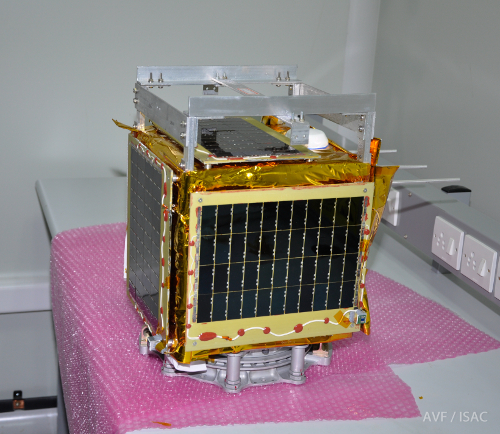
India's first satellite built entirely by university students, measuring ionospheric total electron content over the Indian subcontinent.
Technical specifications
- Mass
- 10.15 kg
- Structure
- 30 cm-sided cube, Aluminum alloy (Al 6061) side panels
- Power
- Li-ion battery + 4 deployable solar panels
- Beacon
- 145.98 MHz CW (Morse code)
- Telemetry
- 437.455 MHz FSK/AX.25
- Orbit
- Polar sun-synchronous, ~670 km
- Payload
- Total Electron Content (TEC) ionospheric sensor, 1km x 1km resolution over India
- Launch
- PSLV-C35, 26 September 2016, Satish Dhawan Space Centre
About
Pratham was conceived, designed, built, and tested entirely by students of IIT Bombay’s Student Satellite Program over roughly a decade, with guidance from ISRO and IITB faculty under Prof. K. Sudhakar. It launched on 26 September 2016 aboard ISRO’s PSLV-C35 from Satish Dhawan Space Centre, Sriharikota, as part of a multi-satellite rideshare — India’s first satellite built solely by students of an engineering institute. Pratham’s mission was to measure total electron content (TEC) in the Earth’s ionosphere over the Indian subcontinent at high spatial resolution (1km x 1km grid), data with applications such as improving GPS accuracy. The satellite operated in a polar sun-synchronous orbit at approximately 670 km altitude, communicating via a 145.98 MHz CW beacon and a 437.455 MHz AX.25 telemetry downlink, for roughly four months.
Documentation
No public datasheet yet — request the datasheet / ICD from the supplier.