Nanosatellite Power Subsystem
 Stellar Exploration, Inc.
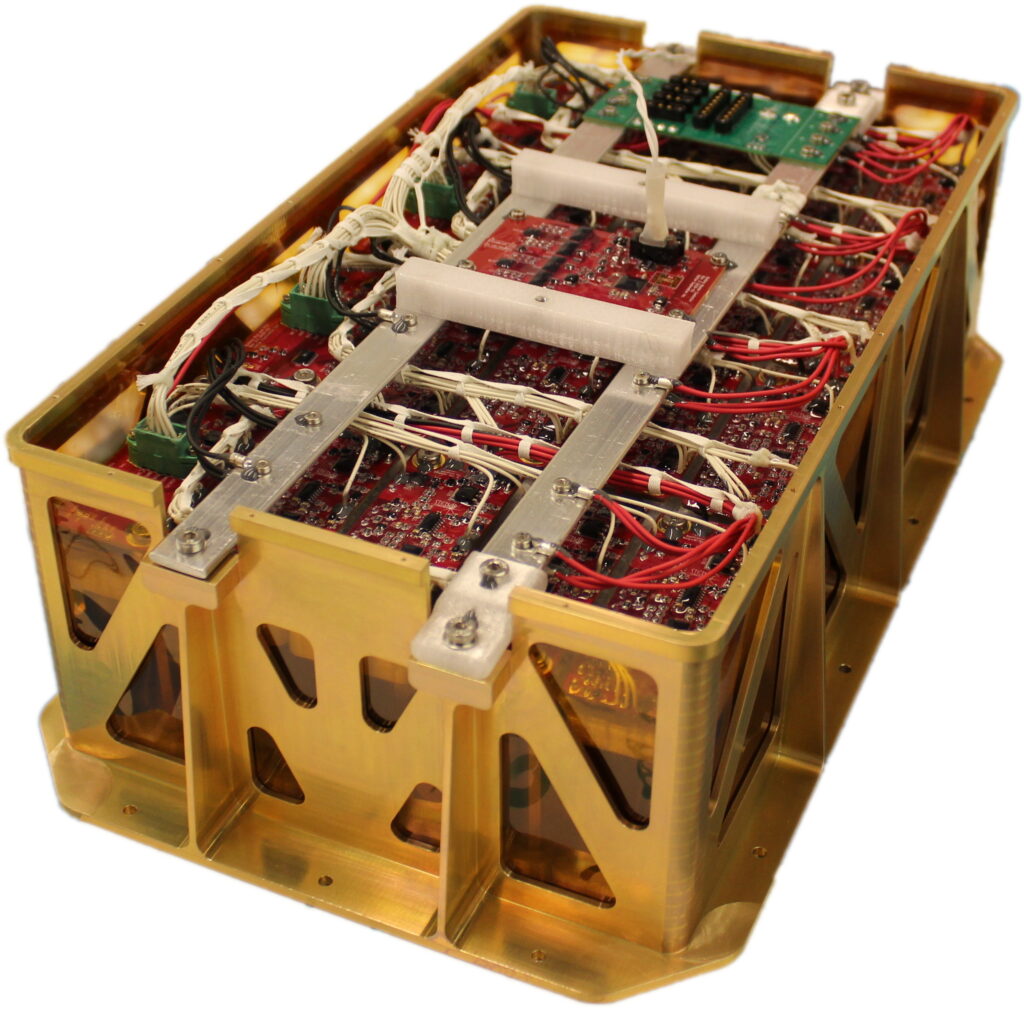
High-current, long-life lithium-ion nanosatellite battery and power management subsystem with flight heritage on 24+ satellites.
Typed specifications32 values
Discloses 6 of 12 fields engineers filter by in this category (category median 5).
- Energy
- 3 000 Wh 40 modules (adjustable 70 Wh - 3 kWh) · datasheet p.2 70 Wh single module | 70 Wh single module (adjustable 70 Wh - 3 kWh)
- Cell chemistry
- Li-ion (unspecified) COTS li-ion cells · datasheet p.1
- Cycle life
- 30 000 max · up to 30K cycles (depending on usage) · datasheet p.2
- Supply voltage
- 28 V nom. · unregulated · datasheet p.2
- Power consumption
- 250 W peak power per module · datasheet p.2 10 000 W max · peak power, 40 modules
- Data interface
- RS-422 datasheet p.2 RS-422 control and telemetry | CAN | CAN control and telemetry
- Design lifetime
- 3 years min · depending on usage · datasheet p.2 5 years max · depending on usage | 3–5 years operational lifetime (depending on usage)
- Lead time
- 4–6 months product page
- Nominal voltage
- 28 V nom. · bus voltage, unregulated · datasheet p.2
- Battery management / protection electronics
- BMS with charge control integrated hardware providing control of charging, dischargin… · datasheet p.1
- Flight heritage
- Flight-proven hardware; 20 systems (3 programs) launched, more delivered and in the system integration pipeline datasheet p.1
- Satellite class
- CubeSat datasheet p.2 microsat 10-100 kg
- Missions flown
- 20 20 systems (3 programs) launched · datasheet p.1
- Protections
- over-current charge datasheet p.3 over-discharge (UV) excessive discharge | over-temperature over-temperature | over-charge (OV) overcharge | other overcurrent (charge/discharge not distinguished) +4
- Cell balancing
- other each cell has dedicated charge, balance and discharge control · datasheet p.2
Each value is typed with its unit and measurement condition and cites the datasheet page it was taken from. Nothing is guessed: a field that is absent here has not been published by the manufacturer. machine-extracted ✓ checked by NewSpace Market ✓ manufacturer confirmed by the manufacturer.
As published by the supplier10 lines, in the manufacturer's own wording
- Peak power
- Up to 5 kW for 90 seconds per orbit
- Specific peak power
- Up to 500 W/kg
- Design life
- >3 years (projected)
- Flight heritage
- >24 units launched 2018-2021
- Lead time
- 4-6 months
- Battery chemistry
- Lithium-ion, redundant modules with dedicated per-string balancing and control
- Capacity
- 70 Wh (single module) and 3 kWh (40 modules)
- Supply voltage
- 28 V nominal
- Lifetime
- 3-5 years or up to 30K cycles
- Interface
- RS-422 or CAN
About
Stellar Exploration’s nanosatellite power subsystem was developed in response to unique requirements for high peak current with long lifetime (>3 years), at low unit cost. The subsystem includes redundant lithium-ion modules with dedicated balancing and control for each string, in order to maximize lifetime. It can provide up to 5 kW peak power for 90 seconds every orbit, with a projected lifetime exceeding three years, and can be scaled to provide up to 500 W/kg peak power.
The integrated subsystem includes programmable charging and discharging control, failure detection and isolation, multiple watchdog timers, and power-on-reset capability. The battery design can be modified to fit customer-specific mission requirements.
The power subsystem has extensive flight heritage, with more than 24 units launched between 2018 and 2021, including high-current power systems developed for ICEYE’s Synthetic Aperture Radar constellation, where roughly 4,000 lithium-ion cells have been deployed in orbit across all missions to date.
Documentation
Need the full ICD, test reports or a specific revision? Ask the supplier directly.