Ranging and Nanosatellite Guidance Experiment (RANGE)
 Georgia Institute of Technology
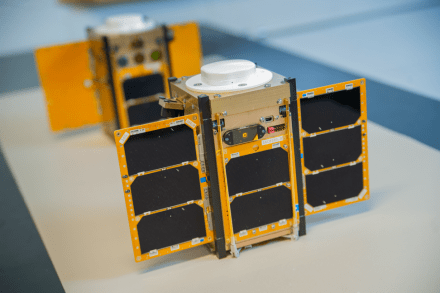
RANGE is a mission consisting of two 1.5U CubeSats designed to demonstrate improved absolute orbital position knowledge and inter-satellite distance measurement using laser ranging and GPS.
Technical specifications
- Project sponsor
- Terra Bella (formerly Skybox) University Cubesat Partnership
- Start date
- 08/25/2015
- Faculty investigator
- Dr. Brian Gunter
- Project status
- Currently in orbit
- Number of cubesats
- Two
- CUBESAT size
- 1.5 U
- Launch date
- December 3rd, 2018
- Launch vehicle
- SpaceX Falcon-9
- Mission
- Spaceflight’s SSO-A
About
The Ranging and Nanosatellite Guidance Experiment (RANGE) mission involves two 1.5U CubeSats flying in a leader-follower formation. The primary goal is to significantly improve the relative and absolute positioning capabilities of nanosatellites. Absolute positions of the satellites are tracked using GPS receivers synchronized with miniaturized atomic clocks, with validation provided by ground-based laser ranging measurements. For relative positioning, an on-board compact laser ranging system is utilized, which also functions as a low-rate optical communication system. The mission does not employ an active propulsion system; instead, the separation distance between the satellites is controlled through differential drag techniques. The successful outcomes of the RANGE mission are expected to enable more advanced payloads and future mission concepts that involve formations and constellations of nanosatellites. RANGE successfully launched into orbit on December 3rd, 2018, aboard a SpaceX Falcon-9 rocket as part of Spaceflight’s SSO-A mission, marking Georgia Tech’s first small satellite to reach orbit. The mission is currently in its operations phase.
Documentation
No public datasheet yet — request the datasheet / ICD from the supplier.