Photon
 Rocket Lab
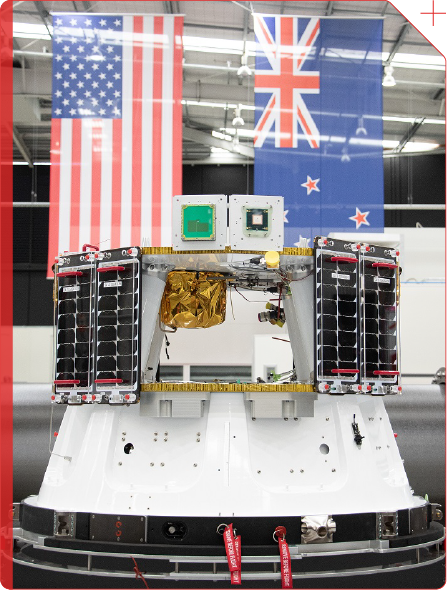
Configurable spacecraft platform and in-space transportation stage for LEO, high-Earth orbit, lunar, and interplanetary missions.
Typed specifications2 values
Discloses 1 of 7 fields engineers filter by in this category (category median 3).
- Max payload mass
- 170 kg max · product page
- Propulsion
- included product page
Each value is typed with its unit and measurement condition and cites the datasheet page it was taken from. Nothing is guessed: a field that is absent here has not been published by the manufacturer. machine-extracted ✓ checked by NewSpace Market ✓ manufacturer confirmed by the manufacturer.
As published by the supplier6 lines, in the manufacturer's own wording
- Propulsion
- HyperCurie engine (HTP / isopropyl alcohol)
- Specific impulse
- ~220 s
- Mission reach
- LEO, MEO, GEO, lunar, interplanetary
- Power
- Deployable solar panels
- Payload capacity
- Up to 170 kg (mission dependent)
- Notable mission
- NASA CAPSTONE — translunar injection to NRHO (2022)
About
Photon is Rocket Lab’s configurable spacecraft platform, available both as a standalone satellite bus for commercial and government customers and as a mission extension stage that integrates with Electron’s upper stage to deliver payloads beyond standard LEO altitudes.
In its spacecraft bus form, Photon is a fully operational satellite with power, propulsion, communications, and data handling systems — customers can fly Photon as a hosted payload platform or provide their own satellite bus that Photon delivers to the target orbit. Rocket Lab offers Photon-based missions under a Spacecraft as a Service model, managing manufacturing, testing, launch integration, and early-orbit operations.
Photon has enabled Electron to reach high Earth orbit and translunar injection trajectories. NASA’s CAPSTONE mission used a Photon stage to propel the 25 kg CAPSTONE CubeSat on a ballistic lunar transfer trajectory to the lunar Gateway’s planned Near Rectilinear Halo Orbit (NRHO) in 2022, demonstrating Photon’s deep-space transfer capability.
Propulsion is provided by a HyperCurie engine burning high-test peroxide (HTP) and isopropyl alcohol, providing a specific impulse of approximately 220 seconds — sufficient for significant orbit-raising maneuvers across multiple months of operations.
Documentation
No public datasheet yet — request the datasheet / ICD from the supplier.