nSight-2 3U nano-satellite
 SCS Space
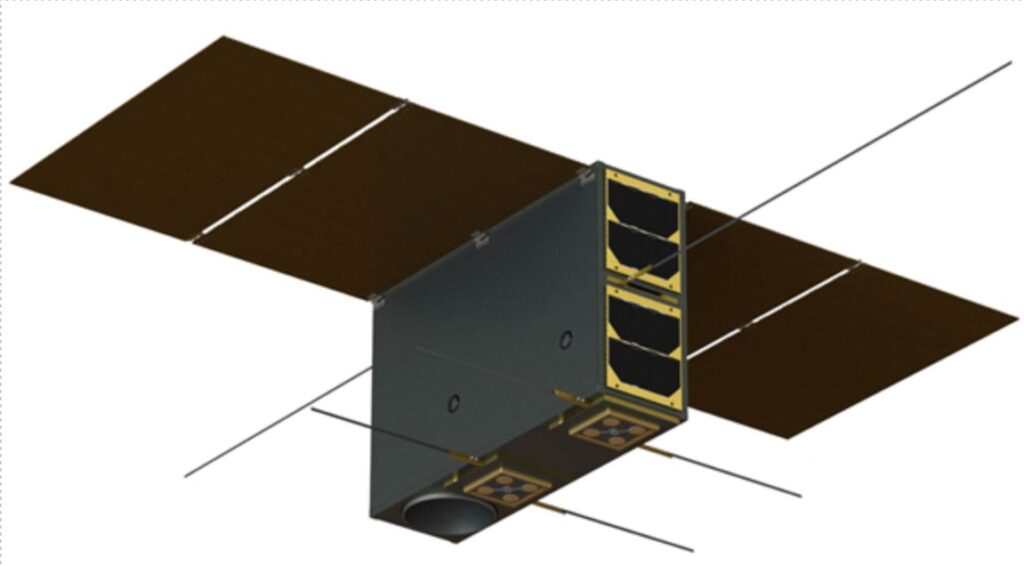
nSight-2 is a 3U nano-satellite with a mass of less than 6 kg and a 3-year design lifetime, equipped with a Mantis imager for multi-spectral or hyperspectral data collection.
Key figurescomparable across the catalogue
- Mass
- 6 kg
- Design life
- 3 years
Normalised to common units so this product can be compared with others in its category. The supplier's own wording is below.
As published by the supplier
- Form factor
- 3U nano-satellite
- Mass
- less than 6 kg
- Design lifetime
- 3 year
- Imager (baseline)
- Mantis imager
- Multi-spectral dataset
- up to 6 spectral lines with 16 m GSD pixels
- Hyperspectral dataset
- 32 m
- Spatial resolution (GSD)
- 16m or 32m
- Swath width
- 32 km
- Onboard storage
- 128 GigaByte
- Imager heritage
- Gecko imager (operating successfully on nSight-1 CubeSat since 25 May 2017)
- Bus heritage
- nSight-1 2U nanosatellite mission
About
The nSight-2 is a 3U nano-satellite designed for operational missions in Low Earth Orbit. It has a mass of less than 6 kg and a design lifetime of 3 years. The satellite is equipped with a Mantis imager as its baseline payload, capable of collecting multi-spectral datasets of up to 6 spectral lines with 16 m GSD pixels, or a 32 m hyperspectral dataset. The spatial resolution (GSD) of 16m or 32m is achieved at a swath width of 32 km. The satellite includes 128 GigaByte of onboard storage. The imager’s design is based on experience with the smaller Gecko imager, which has achieved space heritage and has been successfully operating on the nSight-1 CubeSat since May 25, 2017. The bus itself also has heritage from the nSight-1 2U nanosatellite mission. The nSight-2 represents a new class of operational small satellites, aiming to set a new price/performance benchmark by leveraging advances in payload technology, miniaturization of electronics, and standardized mechanical engineering.
Documentation
No public datasheet yet — request the datasheet / ICD from the supplier.