Solar Panels
 Ananth Technologies
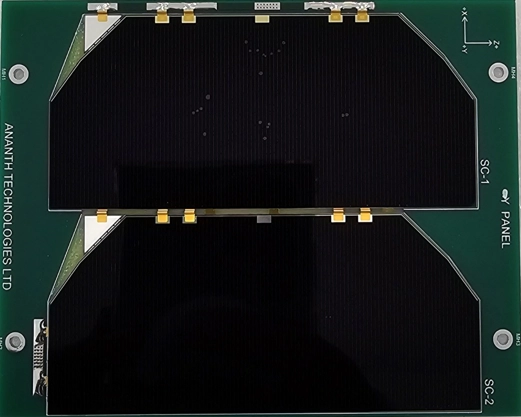
Ananth Technologies designs and manufactures high-performance solar panels for satellites ranging from CubeSats to advanced microsatellites, combining flight-proven materials, precision engineering, and comprehensive environmental testing.
Typed specifications12 values
Discloses 0 of 12 fields engineers filter by in this category (category median 3).
- Envelope (L×W×H)
- up to 1.5 m × 2.5 m product page
- Form factor (as printed)
- Up to 1.5m × 2.5m product page 336 × 205 mm | PCB | 2 cells in series | ~2 W +5
- Operating temperature
- -60 °C product page
Each value is typed with its unit and measurement condition and cites the datasheet page it was taken from. Nothing is guessed: a field that is absent here has not been published by the manufacturer. machine-extracted ✓ checked by NewSpace Market ✓ manufacturer confirmed by the manufacturer.
As published by the supplier20 lines, in the manufacturer's own wording
- Cell type
- Triple-junction GaAs
- Efficiency
- Up to 31%
- Operating temperature
- -60°C to +110°C
- Radiation tolerance
- 1E15 e/cm²
- Mission life
- 15+ years
- Large panel size
- Up to 1.5m × 2.5m
- Power density
- ~230-250 W/m²
- CUBESAT solar panels (1u–16u) substrate
- PCB
- CUBESAT solar panels (1u–16u) cells
- 2 cells in series
- CUBESAT solar panels (1u–16u) pmax
- ~2 W
- CUBESAT solar panels (1u–16u) size
- 83 × 103.2 mm
- CUBESAT solar panels (1u–16u) size (2)
- 206.5 × 321.3 mm
- CUBESAT solar panels (1u–16u) substrate (2)
- FR-4
- CUBESAT solar panels (1u–16u) configuration
- 5S × 3P
- CUBESAT solar panels (1u–16u) substrate (3)
- CFRP plate + FR-4 flex circuitry
- CUBESAT solar panels (1u–16u) size (3)
- 336 × 205 mm
- Microsatellite solar arrays deployed frequency
- greater than 2 Hz
- Large-format satellite solar panels dimensions
- up to 1.5 m × 2.5 m
- Large-format satellite solar panels power output
- ~230-250W per square meter
- Large-format satellite solar panels lightweight
- ~2 kg per square meter of array blanket mass
About
Ananth Technologies designs and manufactures high-performance solar panels for satellites ranging from CubeSats to advanced microsatellites. Developed at their Bengaluru space hardware facility, these solar panels combine flight-proven materials, precision engineering, and comprehensive environmental testing to deliver reliable power generation in demanding orbital conditions. Key features include high-efficiency triple-junction solar cells (GaInP/GaInAs/Ge) from leading international suppliers with efficiency up to 31% and integrated cover glass for radiation and particulate protection. The robust electrical design incorporates a magnetically clean layout, parallel gap resistance welding for cell interconnection, customizable string configurations (parallel/series), built-in bypass and isolation diodes for shading protection, and low-outgassing RTV silicone adhesive for solar cell bonding. Precision mechanical structures offer multiple substrate options: PCB/FR-4 for CubeSats, CFRP plate + FR4 flex for larger configurations, and Aluminium honeycomb with CFRP face skins for microsatellite and large-format panels, along with space-grade hinges, hold-and-release mechanisms, and deployment systems. Customizable interfaces include flexible mounting hole patterns and panel dimensions, external temperature sensors with configurable I²C addresses, and Micro-D electrical connectors with custom bracket options. Applications span communication satellites, Earth observation satellites, navigation satellites, scientific missions, CubeSats and nanosatellites, and LEO constellations. The product portfolio includes CubeSat Solar Panels (1U–16U) with various substrates and configurations, customized deployable solar arrays for microsatellites up to the 100-kg class and beyond (featuring aluminium honeycomb core with CFRP face sheets, precision-engineered hinges and deployment mechanisms, integrated temperature sensors, sun sensors, and isolation diodes, and deployed frequency greater than 2 Hz), and large-format satellite solar panels for advanced satellites requiring high power, based on aluminium honeycomb structures with CFRP skins. Customization capabilities cover panel geometry and size, solar cell type and configuration, deployable array mechanisms, connector and harness layout, mechanical interfaces and hinge systems, thermal design and sensor integration, and full documentation, testing, and qualification support.
Documentation
No public datasheet yet — request the datasheet / ICD from the supplier.