Starfire (Direct Fusion Drive)
 Princeton Satellite Systems
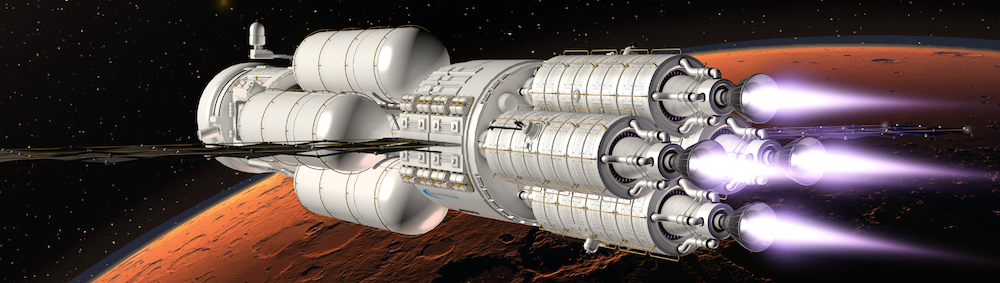
Compact fusion-powered rocket engine developed with Princeton Plasma Physics Lab, targeting 1–10 MW per engine for deep space missions to Mars, Jupiter, and beyond.
Typed specifications2 values
Discloses 1 of 10 fields engineers filter by in this category (category median 3).
- Propellant
- other fusion fuel: deuterium + helium-3 · product page
- Power consumption
- 1–10 W product page
Each value is typed with its unit and measurement condition and cites the datasheet page it was taken from. Nothing is guessed: a field that is absent here has not been published by the manufacturer. machine-extracted ✓ checked by NewSpace Market ✓ manufacturer confirmed by the manufacturer.
As published by the supplier6 lines, in the manufacturer's own wording
- Power output
- 1–10 MW per engine
- Fuel
- Deuterium–Helium-3 (D-He3)
- Configuration
- Princeton Field-Reversed Configuration (PFRC)
- Heating method
- Odd-parity RF heating, steady-state closed-field
- Target missions
- Human Mars orbit, Jupiter/Uranus probes, asteroid deflection
- Propulsion class
- Compact fusion propulsion and power generation
About
Starfire (formerly Direct Fusion Drive / DFD) is Princeton Satellite Systems’ compact fusion-powered propulsion technology, developed in collaboration with Princeton Plasma Physics Laboratory (PPPL) based on the Princeton Field-Reversed Configuration (PFRC) plasma confinement concept. It combines power generation and propulsion in a single compact unit, producing both thrust and electric power.
Unlike conventional nuclear propulsion, Starfire uses odd-parity RF heating in a steady-state closed-field plasma configuration fueled by Deuterium-Helium-3 reactions, targeting no radioactive waste. Each engine targets 1–10 MW output with high specific power and low mass, enabling missions that are impractical with chemical or electric propulsion alone — including human Mars orbit missions, outer planet probes (Jupiter, Saturn, Uranus), and asteroid deflection. The technology is supported by R&D contracts from NASA and DoD.
Documentation
No public datasheet yet — request the datasheet / ICD from the supplier.