T-Minus DART
 T-Minus Engineering
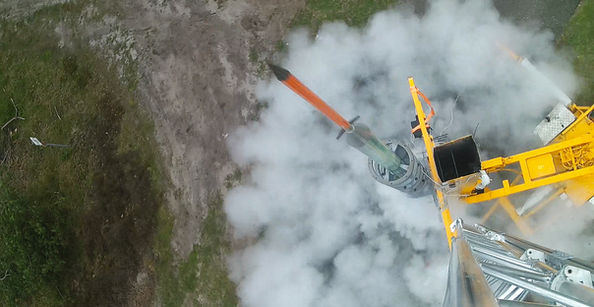
The T-Minus DART is a low-cost, rapidly deployable sounding rocket system designed for probing the upper atmosphere (50-120 km altitude) and launching small scientific payloads above 120 km.
Key figurescomparable across the catalogue
- Mass
- 22 kg
- Payload capacity
- 0.5 kg
- Total impulse
- 4,300 N·s
Normalised to common units so this product can be compared with others in its category. The supplier's own wording is below.
As published by the supplier
- Booster motor diameter
- 0.118 [m] (Viper IIA compatible)
- Booster motor length
- 2.3 [m]
- Booster motor burn time
- 5 [s]
- Booster motor average thrust
- 8 [kN]
- Booster motor propellant mass
- 22 [kg]
- Booster motor loaded mass
- 29 [kg]
- Booster motor propellant type
- AP composite
- Booster motor casing material
- Carbon fiber reinforced plastic
- Booster motor nozzle material
- Aluminum/graphite
- Dart diameter
- 35 mm
- Dart length
- 1.2 m
- Dart total mass
- 3.5 kg
- Dart payload mass
- 0.5 kg
- Maximum payload volume (DxL)
- 30 x 250 mm
About
The T-Minus DART is a system for fast and low-cost probing of the upper atmosphere, specifically targeting altitudes between 50 and 120 km where traditional balloons cannot float and satellites cannot maintain orbit. This sounding rocket system is designed to fill the void for in-situ measurements in this region, offering a more affordable and frequent alternative to conventional sounding rockets. It can launch small payloads to altitudes above 120 km, allowing them to descend through the atmosphere and perform measurements. The vehicle comprises a lightweight and powerful booster motor and a dart-shaped payload compartment. The booster has a diameter of 118 mm, making it compatible with existing Viper IIIA launch equipment. The dart’s diameter is only 35 mm to minimize drag losses.
Three types of payload are envisioned: passive payloads (e.g., reflective chaff or inflated spheres), a ‘Smart-dart’ with PTU sensors and inertial or GPS-based flight path determination, and customized payloads with customer-designed sensors, service systems, and telemetry links. The maximum payload volume is 30 x 250 mm (DxL). An optional recovery/deceleration system can be used to increase measurement time. Beyond scientific probing, the DART also serves as an excellent range test vehicle due to its small size, low cost, and ease of operation, making it ideal for mapping weather conditions in higher atmospheric layers and verifying range equipment like telemetry and radar stations.
Upon ignition, the booster provides thrust for 6.5 seconds. After burnout, aerodynamic forces cause vehicle separation, and the dart coasts to its apogee, approximately 150 seconds into the flight, where the recovery system activates to maximize measurement time. The booster follows a ballistic trajectory to impact. In 2017, the DART project received an Horizon 2020 SME-Instrument grant for a feasibility study aimed at commercialization, including user demand surveys, forming a European consortium for demo launch campaigns, and addressing regulations.
Documentation
- DART leaflet_V2015.pdf www.t-minus.nl ↗
- b7ff60_f56fe10a98464ea08a7933b8dee02749.pdf PDF source: www.t-minus.nl ↗
Need the full ICD, test reports or a specific revision? Ask the supplier directly.