ESAT Educational Nanosatellite
 Theia Space
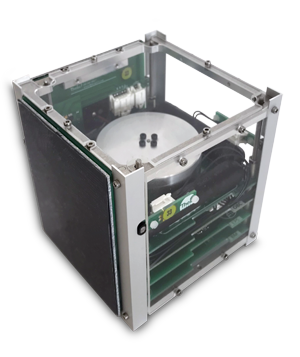
A 1U CubeSat-standard hands-on training satellite used by universities and institutions worldwide to teach real satellite integration and operations.
Typed specifications34 values
Discloses 2 of 7 fields engineers filter by in this category (category median 3).
- Mass
- 1 kg max · product page
- Envelope (L×W×H)
- 110 x 106 x 106 mm ESAT standalone; height x width x depth · datasheet p.17 105 x 105 x 105 mm structure only; height x width x depth
- Data interface
- GPIO OBC general purpose input and output lines · datasheet p.9 USB USB connection; full-speed USB port on OBC | other Wi-Fi (802.11 b/g/n, ESP8266 ESP-01)
- Form factor
- 1U printed as 'CubeSat standard, 10 x 10 x 10 cm' · datasheet p.2
- Regulated voltages for the payload
- 3.3 V 3.3 V buses; voltage range 3.3 V - 3.6 V; unswitchable bus ma… · datasheet p.7 5 V 5 V buses; voltage range 4.6 V - 5.3 V; unswitchable bus max …
- Onboard storage for payload data
- 8 GB max · micro SD card for telemetry storage; cards up to 8 GB tested … · datasheet p.10
- Power generation (orbit average)
- 1 W max · peak; 2 x side solar panels (100 mm x 80 mm), 'up to 1 W powe… · datasheet p.4
- Battery capacity
- 10 Wh max · total stored energy 'up to 10 Wh'; 2 x 1400 mAh Li-Po cells, … · datasheet p.6
- Attitude control
- other one axis (Z) attitude determination and control; reaction (mo… · datasheet p.11
- Attitude knowledge
- 10 ° ±10; magnetic angle accuracy · datasheet p.12 10 ° ±10; solar angle accuracy
- Radio band
- other Wi-Fi 802.11 b/g/n (ESP8266 ESP-01) to ground segment server · datasheet p.9
- Subsystems included
- ADCS attitude determination and control · datasheet p.2 battery battery module, 2 x Li-Po cells | OBC command and data handling / on board computer | EPS electrical power subsystem | ground segment graphical ground segment (Ball Aerospace COSMOS based) +3
- Max satellite wet mass
- 715 g nom. · whole satellite, ESAT standalone weight (incl. thermal payloa… · datasheet p.17 1 kg max · whole satellite; 'Less than 1 kg weigh' (main features)
- Payload board format
- custom 10 cm x 10 cm boards with PC52 double-row system bus connecto… · datasheet p.4
- Payload mounting
- Stacked 10 cm x 10 cm boards with mounting holes and PC52 system bus connector; steel inserts in all threaded holes; M2 hex socket bolts datasheet p.14
- Structure material
- other aluminium alloy machined / anodized aluminium, alloy not stated · datasheet p.14 PEEK or polymer methacrylate panels | stainless steel threaded rods, bolts and nuts
- Material (as printed)
- Machined aluminium top and bottom frames; anodized aluminium corner rails; non-ferromagnetic stainless steel threaded rods, bolts and nuts; 2 mm transparent machined methacrylate side, top and bottom panels datasheet p.14
- Connector
- PC52 rectangular double-row system bus connector datasheet p.4
- Satellite class
- CubeSat 'CubeSat standard' · datasheet p.2
Each value is typed with its unit and measurement condition and cites the datasheet page it was taken from. Nothing is guessed: a field that is absent here has not been published by the manufacturer. machine-extracted ✓ checked by NewSpace Market ✓ manufacturer confirmed by the manufacturer.
As published by the supplier27 lines, in the manufacturer's own wording
- Form factor
- 1U CubeSat
- Dimensions
- 10 x 10 x 10 cm
- Mass
- < 1 kg
- EPS solar panels
- 2 panels
- EPS main board regulation
- MPPT (Maximum Power Point Tracking)
- EPS secondary board regulation
- DET (Direct Energy Transfer)
- EPS battery count
- 2
- EPS energy autonomy
- > 3 hours
- ADCS magnetometer
- 1
- ADCS magnetorquers
- 2
- ADCS momentum wheel
- 1, with tachometer
- ADCS sun sensors
- 4
- Comms duplex mode
- Full-duplex simultaneous TM/TC
- Comms primary frequency band
- 435-525 MHz
- Comms full frequency range
- 0.14-1 GHz
- Comms modulation schemes
- OOK, Binary FSK, Quaternary FSK, GFSK
- C&dh processor
- Programmable processor
- C&dh storage
- Micro SD card
- C&dh debug interface
- USB 2.0
- Thermal payload heater control
- GPIO-controllable heater element
- Thermal payload temperature sensor
- Thermistor
- Gse magnetic field simulator
- Included
- Gse sun simulator
- Included
- Gse turntable
- Included
- Gse ground station
- Included
- Software os support
- Windows, macOS, Linux
- Software license
- Open-source
About
ESAT is an educational nanosatellite designed to be the perfect tool for hands-on training in space engineering at all levels — from elementary schools to university engineering programs and professional companies. Based on the CubeSat standard, the 10x10x10 cm, sub-1 kg platform can be fully assembled, integrated, validated, and operated by students, giving them direct experience with every phase of a real satellite mission lifecycle.
The satellite integrates five core subsystems: an Electrical Power Subsystem (EPS) with solar panels, MPPT regulation, battery boards with DET regulation, and more than three hours of stored energy autonomy; an Attitude Determination and Control Subsystem (ADCS) featuring a magnetometer, two magnetorquers, a momentum wheel with tachometer, and four sun sensors; a Communications Subsystem supporting full-duplex simultaneous telemetry and telecommand in the 435-525 MHz band with OOK, binary FSK, quaternary FSK, and GFSK modulation; a Command and Data Handling (C&DH) board with a programmable processor and Micro SD card storage; and a Thermal Payload with a GPIO-controllable heater element, thermistor temperature sensor, and controllable LED indicators.
Each ESAT kit ships with comprehensive Ground Support Equipment including a magnetic field simulator, sun simulator, turntable, and assembly tools, as well as a dedicated ground station. The open-source software GUI provides real-time telemetry monitoring, numerical field displays, plotting, and telecommand uplink, running on Windows, macOS, and Linux.
ESAT has been endorsed by the ESA Academy for use in official training programs and is deployed at universities and institutions worldwide. All subsystem code is open-source and extensible, enabling custom payload and algorithm development.
Documentation
- THEIA-CI-ESAT001-i1-r0.pdf PDF source: www.theia.eusoc.upm.es ↗
- ESAT-BROCHURE_LOW_RESOLUTION-i1-r1.pdf PDF source: www.theia.eusoc.upm.es ↗
Need the full ICD, test reports or a specific revision? Ask the supplier directly.