Thermal LyNX®
 Thermal Space Ltd.
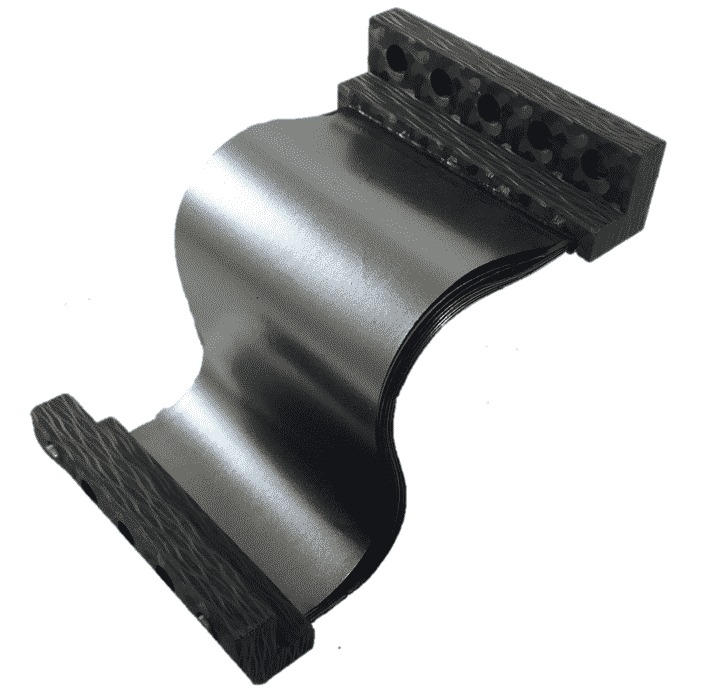
A solid-state graphene thermal strap technology offering superior thermal conductance-to-mass ratio, high flexibility, and NASA-approved low-outgassing materials for spacecraft thermal management.
Key figurescomparable across the catalogue
- Mass
- 2 kg
Normalised to common units so this product can be compared with others in its category. The supplier's own wording is below.
As published by the supplier
- Thermal conductivity-to-mass ratio
- ~2x better than other thermal strap types
- Thermal conductivity vs. aluminum (at ~220 K)
- 16x per unit mass
- Thermal conductivity vs. copper (at ~220 K)
- 27x per unit mass
- Elastic modulus vs. graphite fiber
- ~20x lower (much more flexible)
- Thermal conductivity-to-density ratio
- >2x graphite fiber
- Construction
- Layered graphene foil with carbon-composite end fittings
- Outgassing
- NASA-approved low-outgassing materials, no particulate contamination
- Configuration options
- Straight, curved, or twisted, from millimeters to feet in length
- Optional outer wrap
- Aluminized Mylar or Kapton
About
Thermal LyNX® is Thermal Space Ltd.’s solid-state thermal strap technology built around a Layered Nanostructured Cross(X)-Linked (LyNX) graphene material, marketed under the brand SpaceStraps.com. Developed primarily for use in space where mass is critical, it is based on nanostructured pure carbon (layered graphene foil, LGF) providing more than twice the thermal conductance-to-mass ratio of any other previously available thermal strap technology. Its advantage over conventional metals peaks around 220 K, where thermal conductivity per unit mass is 16 times that of aluminum and 27 times that of copper. Compared to high-conductivity graphite fiber thermal straps, the graphene foil used in Thermal LyNX® has more than double the thermal conductivity-to-density ratio, while its modulus is nearly 20 times lower than graphite fiber, giving a strap roughly 20 times less stiff (more flexible) in the same configuration. Unlike delicate pyrolytic graphite sheet (PGS) or graphene composite/sheet materials, Thermal LyNX® is robust, does not fracture or splinter, and can withstand sharp bending without performance degradation, eliminating the need for protective encapsulation that would otherwise limit flexibility, range of motion, or introduce temperature limits. The straps are volumetrically streamlined and offer orders of magnitude greater mechanical flexibility and range of motion than graphite fiber thermal straps historically used in space systems. Construction typically uses high-modulus carbon composite end fittings (terminals/mounts) precisely CNC-machined for interfacing via threaded fasteners, adhesives, or clamping, with features such as holes, slots, pins for alignment/registration, and standard or locking threaded inserts for a range of fastener options. All materials are well below published NASA outgassing limits, making the straps suitable for spaceflight systems. Thermal LyNX® is available in standard and custom configurations, from straight to curved or twisted geometries, in sizes ranging from millimeters to feet, and can be directly integrated with aluminized Mylar (polyester) or Kapton (polyimide) layers for added thermal and mechanical protection without compromising flexibility.
Documentation
No public datasheet yet — request the datasheet / ICD from the supplier.