Ut ProSat-1
 Virginia Tech
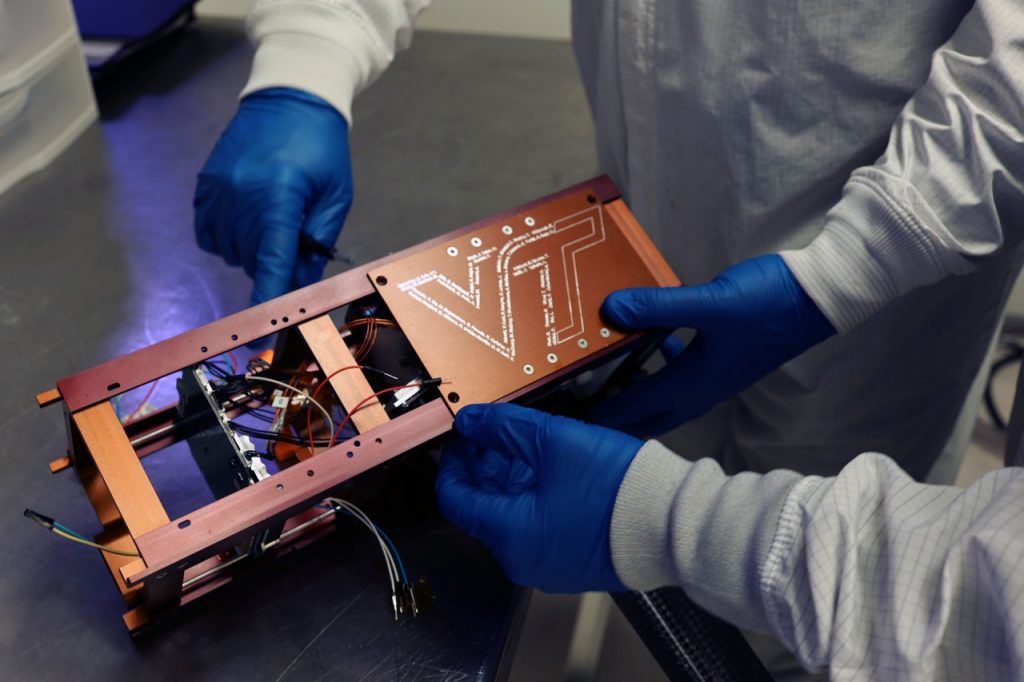
The Ut ProSat-1 is a 3U CubeSat developed by Virginia Tech students to test NASA's ultralightweight deployable boom technology and serve as a platform for successive space experiments.
Technical specifications
- Form factor
- 3U CubeSat
- Primary payload
- NASA Langley Research Center’s ultralightweight deployable boom technology
- Avionics system
- In-house built (power, battery, radio, communications units)
- Payloads
- 3 (primary being the boom deployer)
- Deployment monitoring
- Visible light camera, infrared camera, encoder, inertial measurement unit
- Boom material
- Polymer material reinforced with carbon fiber, with copper traces
- Mission duration (expected)
- Approximately 10 days
- Launch vehicle
- Antares rocket (as part of Northrop Grumman’s Cygnus NG-19 resupply mission)
- Launch location
- Wallops Island, Virginia
- Partnerships
- NASA Langley Research Center, Virginia Institute for Spaceflight and Autonomy, Virginia Commercial Space Flight Authority
About
The Ut ProSat-1 is a 3U CubeSat developed by a team of Virginia Tech researchers and students. It is designed for space launch qualification testing and will serve as a testbed for NASA Langley Research Center’s ultralightweight deployable boom technology. This mission builds upon lessons learned from the previous ThickSat, incorporating upgraded deployable structures and materials technologies. The satellite’s avionics system, including power, battery, radio, and communications units, was built in-house by the Virginia Tech team. The primary payload is a boom deployer, which will be tested for reliability by deploying the arm multiple times. The mission will use a visible light camera to capture images of the fully deployed boom for ground confirmation, an infrared camera to record temperature measurements during deployment and retraction, an encoder to track the angular position of the spool, and an inertial measurement unit to record acceleration at the tip of the boom. The boom itself is unique for its inclusion of copper traces along its entire length, enabling power, control, and data reception from a sensor at the boom tip. Data collected from these experiments will inform the design of future larger-scale composite solar sail systems for applications such as space weather early warning satellites, near-Earth asteroid reconnaissance, or communications relays for crewed exploration missions. The mission is expected to last approximately 10 days, depending on orbital configurations. Key success criteria include establishing uplink/downlink communication with the Virginia Tech Ground Station, commissioning the spacecraft into science mode, and confirming deployment through the decoder and multiple camera images. The project provides students with hands-on experience in designing, fabricating, assembling, and validating a satellite.
Documentation
No public datasheet yet — request the datasheet / ICD from the supplier.