VCUB1 Nanosatellite Platform
 Visiona Tecnologia Espacial
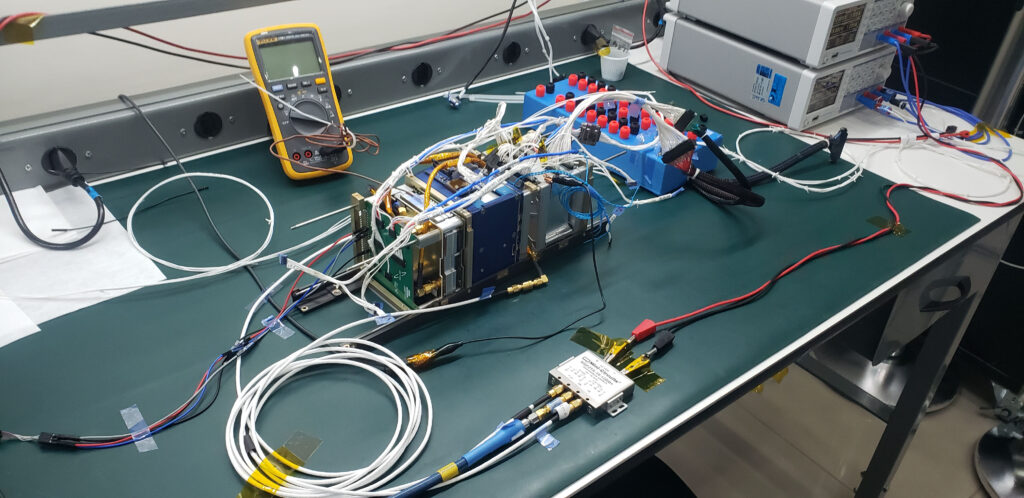
Scalable 3U-to-27U+ nanosatellite platform, the first Earth-observation and data-collection satellite designed entirely by Brazilian industry.
Typed specifications3 values
Discloses 1 of 7 fields engineers filter by in this category (category median 3).
- Mass
- 12 kg product page
- Form factor
- 3U product page 27U
Each value is typed with its unit and measurement condition and cites the datasheet page it was taken from. Nothing is guessed: a field that is absent here has not been published by the manufacturer. machine-extracted ✓ checked by NewSpace Market ✓ manufacturer confirmed by the manufacturer.
As published by the supplier9 lines, in the manufacturer's own wording
- Form factor
- Scalable 3U to 27U+
- Mass
- 12 kg (baseline configuration)
- Optical resolution
- 3.5 m panchromatic
- Camera payload
- OPTO 3UCAM — push-broom, Time-Delayed Integration (TDI), high-frequency gyroscope
- Attitude & orbit control
- First Brazilian-developed AOCS; ultra-stabilized platform with reaction wheels
- Data-collection payload
- Bidirectional UHF, hydro-meteorological data collection, expandable to IoT/telecom missions
- Communications
- Onboard software-defined radio (RDS)
- Design standards
- ECSS and NASA standards; Model-Based Systems Engineering
- Imaging bands
- Panchromatic and Red Edge, optimized for agricultural/environmental monitoring
About
VCUB1 is Visiona’s nanosatellite platform and the first Earth-observation and data-collection satellite conceived and designed end-to-end by Brazilian industry. Built to ECSS and NASA standards using Model-Based Systems Engineering, the scalable 3U-to-27U+ architecture carries a dual payload capable of simultaneously collecting optical imagery and communications/IoT data. The mission validated Brazil’s first domestically developed satellite Attitude and Orbit Control System (AOCS), an onboard software-defined radio (SDR), and an ultra-stabilized platform with reaction wheels for high radiometric and geometric image quality. VCUB1 follows a software-defined-satellite concept, allowing in-flight reconfiguration for new applications, and its bidirectional UHF data-collection payload targets hydro-meteorological sensor networks as well as future IoT and communications missions. The camera payload (OPTO 3UCAM) uses a push-broom sensor with Time-Delayed Integration (TDI) and a high-frequency gyroscope for motion compensation, delivering 3.5 m panchromatic resolution optimized for agricultural and environmental monitoring, including Red Edge band imaging. The program was developed with a network of Brazilian technology partners including OPTO, AMS Kepler, Metalcard and Orbital Engenharia, with financial support from EMBRAPII and the SENAI Innovation Institute.
Documentation
No public datasheet yet — request the datasheet / ICD from the supplier.