Yuri ScienceTaxi BioSpin
 Yuri
Yuri
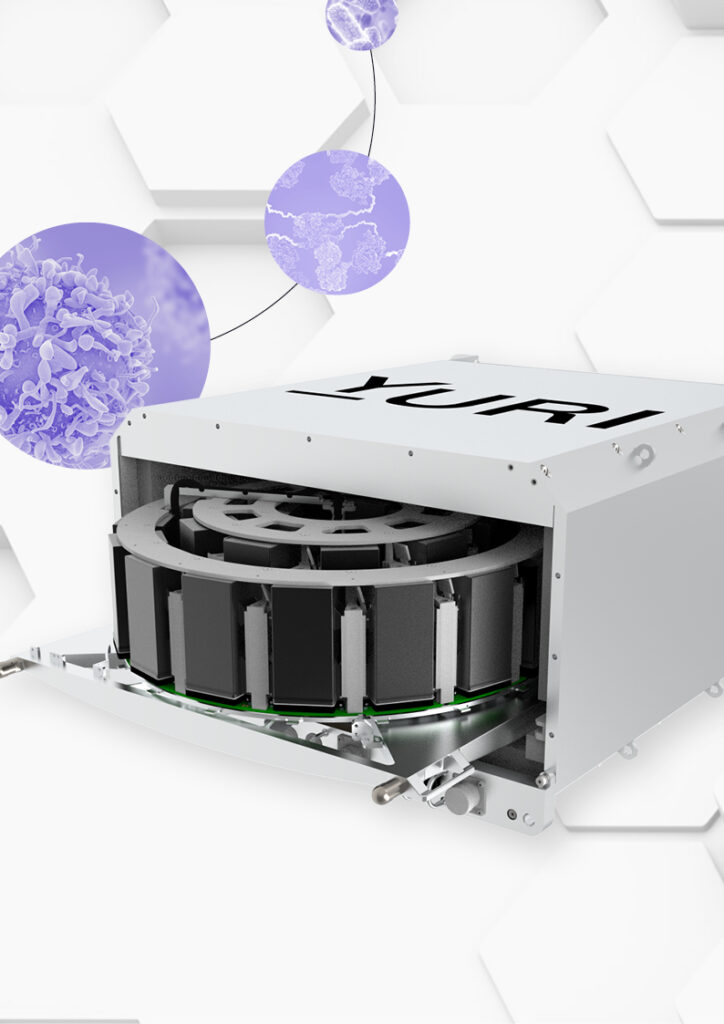
Centrifuge-equipped variant of ScienceTaxi enabling up to 38 individual life-science experiments per launch with adjustable simulated gravity.
Technical specifications
- Experiment capacity
- Up to 38 individual experiments per launch
- Gravity control
- Adjustable centrifuge gravity levels, referenced to Earth, lunar, or Martian gravity
- Temperature control
- Controlled temperatures with real-time data collection
- Development time
- Developed and tested for 3.5 years by Yuri's Luxembourg engineering team
- Maiden mission
- HUMB mission, Cygnus NG-23, launched September 2025
- Launch/transfer
- Launched on Cygnus; transferred to SpaceX Dragon while docked at ISS
- Internal Volume
- 57000 standard length: 400 mm width: 380 mm height: 190 mm
- Payload mass
- < 33 kg
- Lifetime
- 8 years of service lifetime
- Power
- 75 W (min) and 150 W (max)
- Supply voltage
- 24-32.5 V
- Interface
- 8P8C Modular Shielded Jack (RJ-45)
- Cooling air flow
- 12 cfm Minimum 36 cfm Maximum
- Cooling air inlet temperature
- 18,3 °C Minimum 29,4 °C Maximum
- Operating temperature
- +4°C to +40°C
About
ScienceTaxi BioSpin is Yuri’s centrifuge-equipped incubator facility, a variant of the ScienceTaxi platform. It can host up to 38 individual experiments per launch, with automated systems, controlled temperatures, and real-time data collection. The built-in centrifuge provides adjustable gravity levels, enabling comparative studies referenced to Earth, lunar, or Martian gravity. ScienceTaxi BioSpin premiered on the HUMB mission, launched aboard a Cygnus spacecraft on the Northrop Grumman NG-23 resupply mission in September 2025, where it operated aboard the ISS before being transferred from Cygnus to a SpaceX Dragon. The facility carried multiple ScienceShell experiment containers on its maiden mission, including commercial payloads from Astrobiome and Sophie’s Bionutrients.
Documentation
Need the full ICD, test reports or a specific revision? Ask the supplier directly.