Aurora is a remotely piloted suborbital spaceplane that combines rocket performance with aircraft reliability to provide routine, affordable access to suborbital space and speeds over Mach 3 for high-altitude and high-speed flight missions.
AURORA SPACEPLANE
Aurora is a remotely piloted suborbital spaceplane that combines rocket performance with aircraft reliability to provide routine, affordable access to suborbital space and speeds over Mach 3 for high-altitude and high-speed flight missions.
Description
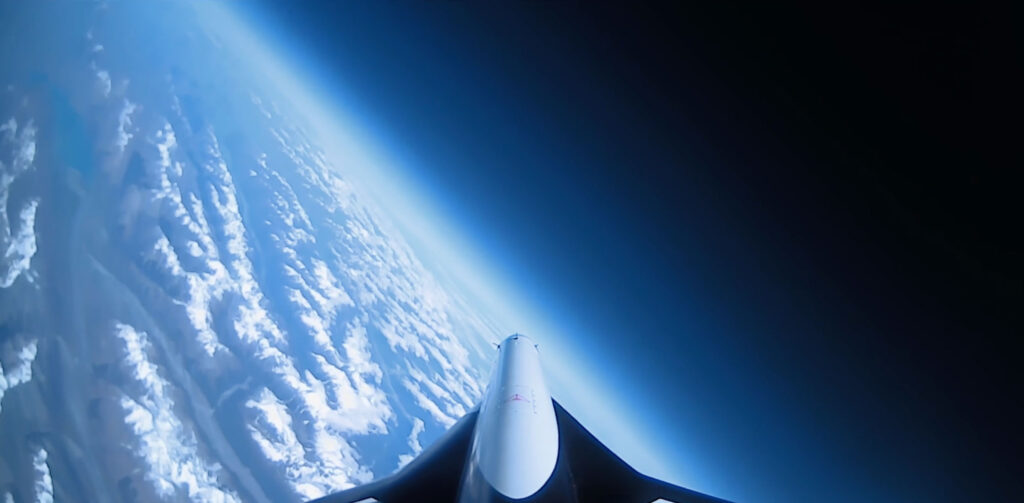
The Aurora Spaceplane is a remotely piloted aircraft (RPAS) designed to offer routine and affordable access to suborbital space, achieving speeds exceeding Mach 3.7. It integrates the performance characteristics of a rocket with the reliability and versatility of an aircraft, making high-altitude and high-speed flights a repeatable part of testing, iteration, and demonstration programs. The vehicle features a restartable rocket engine, conventional aerodynamic control surfaces, and an independent reaction control system for attitude control above the atmosphere. Its composite airframe is built to withstand repeated high-G flights, and onboard data acquisition systems enable comprehensive in-flight monitoring of both the vehicle and its payload performance. Payloads are accommodated in a dedicated bay designed for modular integration, with defined mass, volume, and power envelopes. All systems are optimized for repeatability, rapid turnaround, and routine operations, allowing for frequent suborbital flights from conventional runways.
Aurora supports two primary mission profiles: the Suborbital Profile and the Boost-Glide Profile. The Suborbital Profile is tailored to reach space, maximizing time in microgravity and pointing time for optical payloads, reaching a maximum altitude of 100+ km with an approximate flight duration of 30 minutes and up to 127 seconds of microgravity. The Boost-Glide Profile is optimized for achieving high Mach numbers within the atmosphere for supersonic and target presentation use-cases, capable of reaching speeds up to Mach 3.7 and performing various maneuvers in the supersonic regime.
Flight Heritage: In November 2024, the Aurora spaceplane broke the sound barrier, reaching Mach 1.12 at 82,500 feet. It also set a record for the fastest climb to 20 kilometers (65,600 feet), surpassing a record held by the modified F-15 Streak Eagle set in 1975.
Specifications
| Top speed | Mach 3.7 |
|---|---|
| Max altitude | 100 km |
| Turnaround time | 4 hr |
| Max payload weight | 15 kg (33 lbs) |
| Suborbital profile max alt | 100+ km |
| Suborbital profile approx. flight duration | 30 minutes |
| Suborbital profile max. microgravity time | 127 seconds |
| Boost-glide profile max speed | Mach 3.7 |
| 1st supersonic flight | Mach 1.12 at 82,500 feet (November 2024) |
| Speed record to 20 km (66,000 ft) | 118.6s |