Dawn Aerospace Thrusters (B1, B5, B20, B200)
 Dawn Aerospace
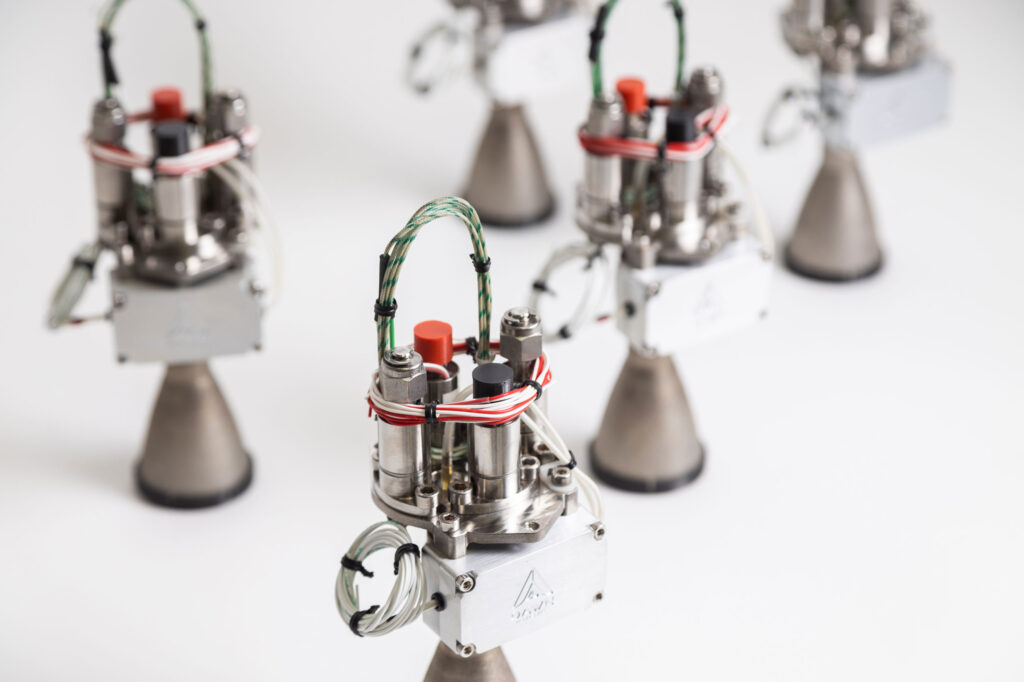
Dawn Aerospace offers a range of non-toxic 'green' chemical propulsion thrusters (B1, B5, B20, B200) using nitrous oxide and propene, designed for various spacecraft sizes and mission profiles.
Typed specifications39 values
Discloses 6 of 10 fields engineers filter by in this category (category median 3).
- Propulsion family
- chemical datasheet p.1
- Mass
- 695 g datasheet p.2
- Thrust
- 6 460 mN min · datasheet p.2 18 110 mN max | 6 460–18 110 mN range
- Envelope (L×W×H)
- 190 x 87 x 82 mm datasheet p.2 190 × 87 × 82 mm incl. keep-out zones
- Specific impulse
- 271 s min · datasheet p.2
- Propellant
- Nitrous oxide (N2O) and Propylene (C3H6) datasheet p.1 other Propylene (C3H6) | other Nitrous oxide (N2O) and Propylene (C3H6)
- Power consumption
- 14.67 W Hit (per valve) · datasheet p.2 0.76 W Hold (per valve) | 4.56 W Igniter max | 14.67 W valve hit, 25 ms, per valve | 0.76 W valve hold, per valve +4
- Operating temperature
- -5 °C min · datasheet p.2 30 °C max | -5–30 °C
- Thruster technology
- bipropellant bi-prop or cold-gas modes · datasheet p.2
- Number of starts or pulses
- 10 000 min · restarts per thruster (10,000+) · datasheet p.2
- Min impulse bit
- 980 mN·s Bi-prop · datasheet p.2 10 mN·s Cold-gas | 980 mN·s min · Bi-prop | 10 mN·s min · Cold-gas
- Survival temperature
- -30 °C min · datasheet p.2 40 °C max | -30–40 °C
- Flight heritage
- 96 in space since 2021. Proven on 16 different spacecrafts. datasheet p.1
- Missions flown
- 16 different spacecraft · datasheet p.1 96 thrusters in space since 2021
- Dry mass
- 695 g datasheet p.2
- Ignition or start
- spark or glow plug Spark-based igniter · datasheet p.2
- Restartable
- yes datasheet p.2
- Pulse repetition rate
- 4 Hz pulse frequency · datasheet p.2
Each value is typed with its unit and measurement condition and cites the datasheet page it was taken from. Nothing is guessed: a field that is absent here has not been published by the manufacturer. machine-extracted ✓ checked by NewSpace Market ✓ manufacturer confirmed by the manufacturer.
As published by the supplier31 lines, in the manufacturer's own wording
- Thrust, range (B20)
- 6.46 to 18.11 N (1.45 to 4.07 lbf)
- Minimum impulse bit (b20) bi-prop
- 0.98 N.s (0.22 lbf.s)
- Minimum impulse bit (b20) cold-gas
- 10 mN.s (0.02 lbf.s)
- Ignition (B20)
- Spark-based igniter
- Pulse frequency (B20)
- 4 Hz
- Restarts (B20)
- 10,000+ per thruster
- Thruster dimensions (B20)
- 176 x 80 x 79 mm (6.93 x 3.15 x 3.11 in)
- Dry mass (B20)
- 695 g (1.53 lbm)
- Nozzle expansion ratio (B20)
- 100:1
- Valves (B20)
- Normally-closed solenoid, Four per thruster (firing and isolation)
- Mounting (B20)
- 3x M5 threaded holes
- Control (B20)
- Operable together or independently
- Firing modes (B20)
- Bi-prop & cold-gas. Switch at will. Managed by not engaging the spark-ignitor.
- Cold-start capable (B20)
- Yes. Highly repeatable
- Flight heritage (B20)
- 100+ successfully launched into orbit
- Thrust, range (B1)
- 0.49 to 1.35 N (0.11 to 0.30 lbf)
- Minimum impulse bit (b1) bi-prop
- 74 mN.s (0.016 lbf.s)
- Minimum impulse bit (b1) cold-gas
- 1.4 mN.s (3.1e-4 lbf.s)
- Ignition (B1)
- Spark-based igniter
- Pulse frequency (B1)
- 4 Hz
- Restarts (B1)
- 18,000+ per thruster
- Thruster dimensions (B1)
- 108 x 79 x 40 mm (4.25 x 3.11 x 1.58 in)
- Dry mass (B1)
- 260 g (0.57 lbm)
- Nozzle expansion ratio (B1)
- 100:1
- Valves (B1)
- Normally-closed solenoid, Two per thruster
- Mounting (B1)
- 4x 3.2 mm holes.
- Control (B1)
- Operable together or independently
- Firing modes (B1)
- Bi-prop & cold-gas. Switch at will. Managed by not engaging the spark-igniter
- Cold-start capable (B1)
- Yes. Highly repeatable
- Flight heritage (B1)
- 50+ successfully launched into orbit on cubesat and small satellite
- Restarts (B5/B200)
- 12,000+
About
Dawn Aerospace’s thruster line includes the B1 (1 N), B5 (5 N), B20 (20 N), and B200 (200 N) ‘green’ chemical propulsion thrusters. These systems utilize nitrous oxide (N₂O) and propene (C₃H₆) as propellants, offering a safer and more cost-effective alternative to traditional toxic fuels like hydrazine. The thrusters are designed for reliable performance in orbit and easier integration on the ground. The B20 is a 20 N thruster suitable for larger orbit changes and delta-V missions for bigger small satellites, including Lunar and Deep space missions. It features an integrated thruster, valves, and control electronics, an additively manufactured Inconel 718 body, health monitoring instrumentation, and standard power/data interfaces. It is operable under ambient conditions for fast ground testing and has a heritage of 100+ units successfully launched into orbit. The B1 is a 1 N class thruster designed for fine attitude control and small maneuvers, particularly for CubeSats and small satellites. It is a core component in Dawn’s CubeDrive modules and can be clustered for 6-axis control. It also features integrated components, an additively manufactured Inconel 718 body, standard interfaces, and ambient operability for ground testing, with 50+ units successfully launched. The B5 (5 N) and B200 (200 N) extend this flight-proven architecture to higher thrust classes, designed for responsive maneuvering, refueling compatibility, and scalable mission performance. All thrusters are self-pressurizing, eliminating the need for separate pressurization systems and regulators, which enhances reliability due to fewer parts and interfaces. They are cold-start capable, pulse-mode capable, and can operate in a cold-gas mode. The non-toxic nature of the propellants makes them easy to handle, lowers risk, and makes them ride-share friendly. Ignition is spark-based, avoiding the need for catalysts.
Documentation
- cfd301_bd4ce3df04e14326b4332c9dfad2b0c8.pdf PDF source: www.dawnaerospace.com ↗
- cfd301_5202e0fd24ab4ac198dcfd77b09e8a20.pdf PDF source: www.dawnaerospace.com ↗
Need the full ICD, test reports or a specific revision? Ask the supplier directly.