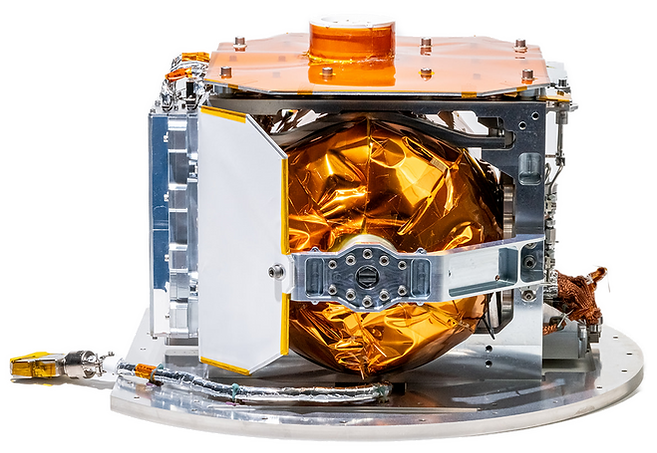
ExoTerra's HALO THRUSTERS product line includes the Halo 8 and Halo 12 Hall-Effect Thrusters, designed for small satellites to achieve optimal orbits, extend mission lifetimes, and perform high-ΔV missions.
HALO THRUSTERS
ExoTerra's HALO THRUSTERS product line includes the Halo 8 and Halo 12 Hall-Effect Thrusters, designed for small satellites to achieve optimal orbits, extend mission lifetimes, and perform high-ΔV missions.

Description
ExoTerra's HALO THRUSTERS product line offers advanced Hall-Effect Thrusters for CubeSats and other small satellites. The Halo 8 is a flight-proven thruster that allows CubeSats to reach optimal orbits, maintain them for long durations, and deorbit on command. It is designed to meet the mass, volume, and thermal constraints of CubeSats and rideshare spacecraft, supporting better science, extended lifetimes, and low-cost lunar and interplanetary missions. The Halo 8 operates at power levels between 100 and 450 W, suitable for satellites from 6U CubeSats to ESPA class, offering superior total impulse performance. It provides a thrust range of 4-30 mN and a specific impulse of 700-1500 s, weighing only 0.83 kg. It has been successfully tested with xenon and krypton, providing propellant flexibility. As of July 1, 2023, four Halo-based integrated propulsion systems are operating in orbit.
The Halo 12 is a Hall-effect thruster-based Electric Propulsion (EP) subsystem, commercialized by ExoTerra from JPL-developed technology. It enables small satellites to perform high-ΔV missions with a total impulse capability of up to 7 MN-s on xenon and up to 4 MN-s on krypton. This makes it suitable for interplanetary, deep space, lunar activities, and long-life LEO & GEO missions. The Halo 12 EP subsystem provides superior performance compared to existing small satellite propulsion technologies, offering up to 110 mN of thrust and 2200 s specific impulse on xenon, and up to 85 mN of thrust and 1850 s specific impulse on krypton, with over 50% total efficiency. It is compact, lightweight, fully throttleable, and capable of >100 kRad TID. The subsystem supports near-Earth and interplanetary missions with on-orbit update capability and options for single or multiple simultaneous string operations. The TRL-5 subsystem is undergoing flight qualification to reach TRL-7 with expected heritage by Q3-4 2023.
Specifications
| Flight heritage | As of July 1, 2023, four Halo-based integrated propulsion systems are operating in orbit. |
|---|---|
| Propellant (Halo 8) | Xenon |
| Mass (Halo 8) | 0.83 kg |
| Volume (Halo 8) | 0.375 U |
| Input power (Halo 8) | 100 – 450 W |
| Total ISP (Halo 8) | 700 – 1500 s |
| Thrust range (Halo 8) | 4 – 30 mN |
| Impulse (Halo 8) | ≥ 375 kN-s |
| Propellant (Halo 8) (2) | Krypton |
| Mass (Halo 8) (2) | 0.83 kg |
| Volume (Halo 8) (2) | 0.375 U |
| Discharge power (Halo 8) | 100 – 300 W |
| Total ISP (Halo 8) (2) | 600 – 1000 s |
| Thrust range (Halo 8) (2) | 4 – 16 mN |
| Impulse (Halo 8) (2) | ≥ 175 kN-s |
| Propellant (Halo 12) | Xenon |
| Input power (Halo 12) | 250 – 1650 W |
| Total ISP (Halo 12) | 900 – 2200 s |
| Thrust range (Halo 12) | 10 – 110 mN |
| Total impulse (Halo 12) | 7 MN-s |
| TRL (Halo 12) | 5 |
| Propellant (Halo 12) (2) | Krypton |
| Input power (Halo 12) (2) | 375 – 1650 W |
| Total ISP (Halo 12) (2) | 1050 – 1850 s |
| Thrust range (Halo 12) (2) | 16 – 85 mN |
| Total impulse (Halo 12) (2) | 4 MN-s |
| TRL (Halo 12) (2) | 5 |