Iris Propulsion Module / Propulsion Kit
 ExoTerra Resource
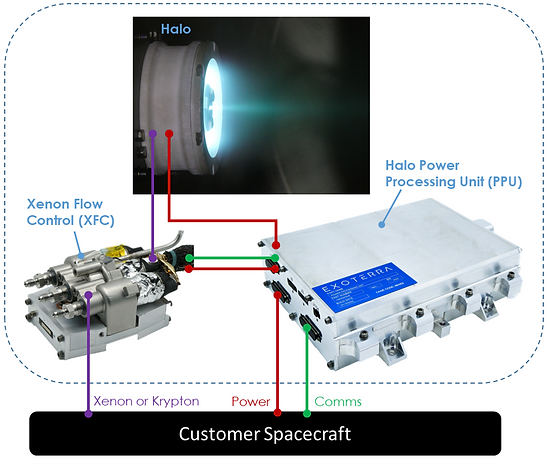
ExoTerra offers the Iris Propulsion Module, a bolt-on solar electric propulsion system for small spacecraft, and a Propulsion Kit consisting of a Hall-effect thruster, Power Processing Unit, and Propellant Flow Control system.
Typed specifications21 values
Discloses 7 of 11 fields engineers filter by in this category (category median 3).
- Propulsion family
- electric Halo thruster with Power Processing Unit · datasheet p.1
- Mass
- 6 kg excluding tank · datasheet p.1
- Thrust
- 4–33 mN datasheet p.1
- Envelope (L×W×H)
- ~32x32x10 cm (as shown) datasheet p.1 32x32x10 cm as shown
- Specific impulse
- 750–1 500 s datasheet p.1
- Total impulse
- 45 000 N·s max · as shown configuration · datasheet p.1 200 000 N·s max · up to, larger tank options
- Propellant
- xenon datasheet p.1 krypton
- Supply voltage
- 22–36 V Input Voltage · datasheet p.1
- Power consumption
- 125–450 W input range · datasheet p.1
- Radiation tolerance (TID)
- 30 krad product page
- Design lifetime
- 5 years datasheet p.1
- Thrusters in the unit
- 1 1/4U Halo Thruster · datasheet p.1
- Volume
- 4 U ~4U, excluding tank · datasheet p.1
- Operating life
- 4 000 h projected, life testing ongoing · datasheet p.2
- Power at thrust
- 125–450 W input power range · datasheet p.1
- Satellite class
- CubeSat datasheet p.1 microsat 10-100 kg Microsatellites
- Power processing unit included
- yes datasheet p.1
Each value is typed with its unit and measurement condition and cites the datasheet page it was taken from. Nothing is guessed: a field that is absent here has not been published by the manufacturer. machine-extracted ✓ checked by NewSpace Market ✓ manufacturer confirmed by the manufacturer.
As published by the supplier6 lines, in the manufacturer's own wording
- Radiation tolerance (Iris)
- 30 kRad TID
- Propellant options (Iris)
- Xenon or Krypton
- Mounting (Iris)
- Inside a standard 24” Lightband
- Height (Iris)
- Less than 30 cm
- Operational power (Iris)
- Low sub-kilowatt levels
- Mission lifetime extension (Iris)
- Up to 5 years
About
ExoTerra’s Iris Propulsion Module is a revolutionary bolt-on Solar Electric Propulsion Module designed for small spacecraft, particularly those in LEO constellations. It offers best-in-class propulsion performance in a packaged solution, allowing rideshare small spacecraft to optimize their mission orbit by adjusting inclination or altitude after a rideshare drop-off. Iris can extend mission lifetime up to 5 years, reduce life cycle costs, enable end-of-life deorbiting, or perform large orbit insertions. The module is designed to mount inside a standard 24” Lightband with a total height of less than 30 cm. Its electronics are radiation tolerant to 30 kRad TID and can operate at low sub-kilowatt levels. For operational flexibility, Iris can use either xenon or krypton as propellant.
In addition to the integrated module, ExoTerra also supplies a Propulsion Kit, which provides a complete propulsion solution as separate components. This kit includes a Hall-effect thruster, a Power Processing Unit (PPU), and a Propellant Flow Control (PFC) system. This modular approach offers customers design freedom, allowing each component to be optimally packaged within their spacecraft. The propulsion system requires only power, serial communications, and propellant as inputs. ExoTerra provides detailed interface documentation and requirements for each component and can offer guidance on the design of harnessing and piping between components.
Documentation
- 21beb8_40b8020bba054058b2e25e816124ec6f.pdf PDF source: www.exoterra.com ↗
- 1452c3_762fb799e1654b91ba0838f7e5f3787c.pdf PDF source: www.exoterra.com ↗
Need the full ICD, test reports or a specific revision? Ask the supplier directly.