
The Multimode Integrated Monopropellant Electrospray (MIME) Thruster is a propulsion system for small satellites that can operate in either a high-thrust chemical mode or a high-specific impulse electric mode using a single propellant and thruster.
Multimode Integrated Monopropellant Electrospray (MIME) Thruster
The Multimode Integrated Monopropellant Electrospray (MIME) Thruster is a propulsion system for small satellites that can operate in either a high-thrust chemical mode or a high-specific impulse electric mode using a single propellant and thruster.
Description
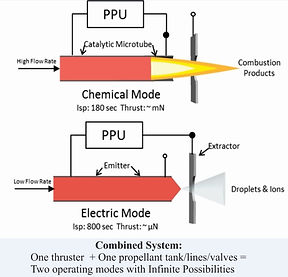
The Multimode Integrated Monopropellant Electrospray (MIME) Thruster is a groundbreaking propulsion system developed by Froberg Aerospace for small satellites. This innovative system utilizes a single propellant, a single feed system, and a single thruster, yet it offers the flexibility to perform both chemical and electric maneuvers. This dual-mode capability can be designed or selected on-orbit, significantly expanding the mission design space for small satellites. It provides enhanced adaptability to changes in mission requirements and enables new, unique capabilities, such as the flexibility to drastically alter the mission profile on-orbit as new scenarios emerge. The MIME Thruster is capable of any maneuver imaginable, on-demand, from large delta-V orbit transfers to rapid rendezvous maneuvers, all within a footprint typical of a single-mode propulsion system. Froberg Aerospace was founded in 2016 to commercialize this multi-mode propulsion technology, which was developed and patented by researchers at Missouri University of Science and Technology. The company was awarded a NASA SBIR Phase I in 2017 and selected for Phase II in 2018 for its 'Multi-Mode Micropropulsion' project. In 2022, Froberg Aerospace was selected for another NASA SBIR Phase I for its 'Multimode Chemical-Electric Propulsion Transfer Stage for Flexible Cislunar Operations'. The company successfully demonstrated high thrust chemical and high Isp electrospray propulsion in the same thruster with the same propellant in December 2020.