BeetleSat Expandable Ka-band Parabolic Antenna
 NSLComm (BeetleSat)
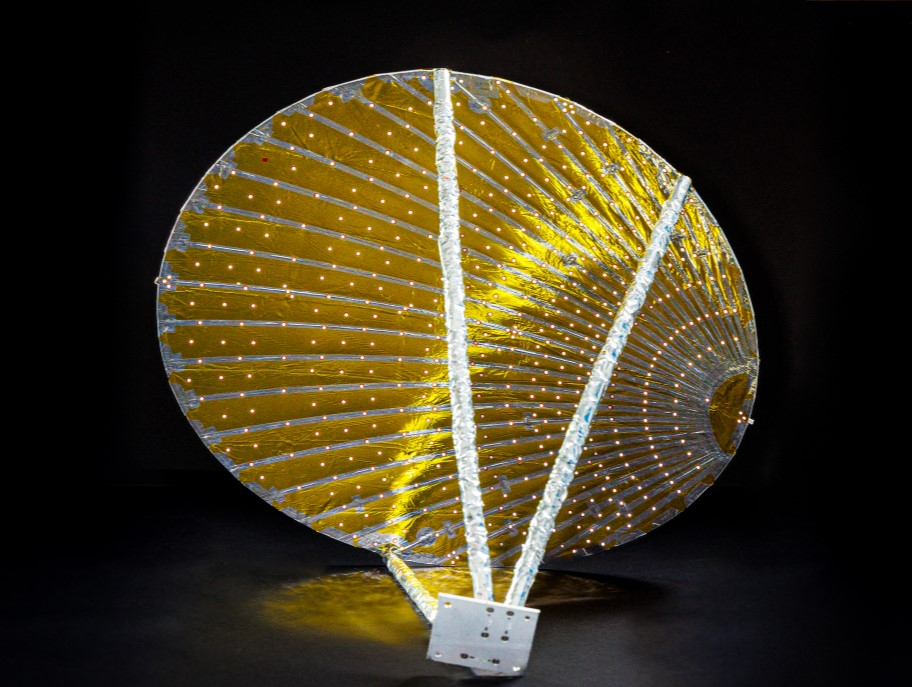
BeetleSat's 60 cm deployable Ka-band parabolic antenna stows into 2U of a 6U CubeSat and deploys in orbit via shape-memory polymer — achieving up to 2 Gbps throughput; first-ever in-orbit deployment from a nanosatellite confirmed May 2023 on BeetleSat-1 at 550 km SSO.
Typed specifications1 values
Discloses 1 of 10 fields engineers filter by in this category (category median 3).
- Antenna type
- deployable reflector (mesh or membrane) product page
Each value is typed with its unit and measurement condition and cites the datasheet page it was taken from. Nothing is guessed: a field that is absent here has not been published by the manufacturer. machine-extracted ✓ checked by NewSpace Market ✓ manufacturer confirmed by the manufacturer.
As published by the supplier13 lines, in the manufacturer's own wording
- Antenna type
- Ka-band deployable parabolic reflector
- Deployed aperture
- 60 cm
- Stowed volume
- 2U (within a 6U CubeSat)
- Mass
- ~140 g (antenna assembly)
- Material
- Proprietary lightweight shape-memory polymer
- Sub-reflector
- FlexoSub — adaptive beam-shaping and steering
- Frequency
- Ka-band
- Data rate
- Up to 2 Gbps
- Throughput improvement
- >100× vs conventional nanosatellite antennas
- Orbit (BeetleSat-1)
- SSO ~550 km
- First in-orbit deployment
- May 2023 (BeetleSat-1 / NSLSat-2)
- Iss demo
- NISSAN experiment — Axiom-1 crew, April 2022
- Planned constellation
- 250–264 Ka-band LEO satellites, ±65° coverage, 2026–2027 service target
About
The BeetleSat Expandable Antenna is NSLComm/BeetleSat’s patented deployable Ka-band reflector — a lightweight (≈140 g) foldable parabolic dish made from proprietary shape-memory polymer that stows compactly inside just 2U of a 6U CubeSat and deploys fully in orbit to a 60 cm aperture. The antenna includes a FlexoSub adaptive sub-reflector that dynamically shapes and steers the beam footprint, enabling beam optimization without mechanical gimbals. Demonstrated on NSLSat-1 (2019) and fully proven in a world-first deployment on BeetleSat-1 / NSLSat-2 (launched January 2023 on SpaceX Falcon 9, deployment confirmed May 2023) in sun-synchronous orbit at approximately 550 km, the antenna achieved two-way Ka-band data communication at up to 2 Gbps — more than 100× the throughput of conventional nanosatellite antennas. A NISSAN (Nano ISS Antenna) technology demonstration experiment flew on the International Space Station with the Axiom-1 crew in April 2022, confirming antenna deployment and shape measurements in a microgravity environment. The antenna architecture forms the backbone of BeetleSat’s planned 250–264 satellite Ka-band LEO constellation targeting mobile network operator backhaul, defense, aviation, and maritime markets, with commercial service planned from 2026–2027. The constellation will cover latitudes ±65°. NSLComm/BeetleSat is an Israeli New Space company and built the BeetleSat-1 satellite in partnership with Clyde Space (UK).
Documentation
No public datasheet yet — request the datasheet / ICD from the supplier.