Dream Chaser
 Sierra Space
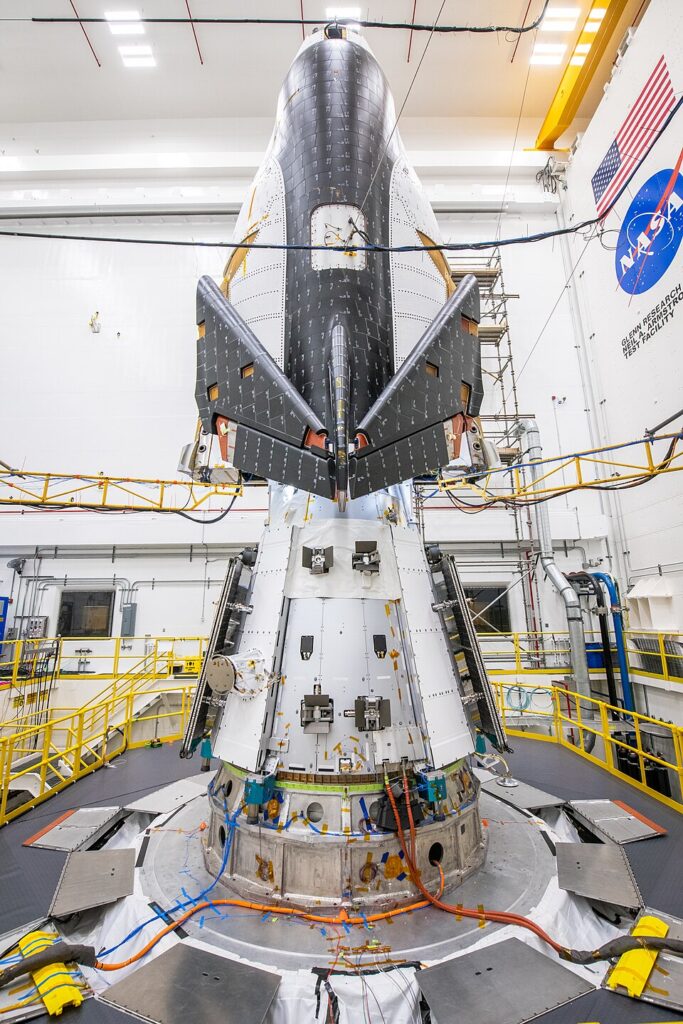
Dream Chaser is an American reusable lifting-body spaceplane developed by Sierra Space, primarily for cargo resupply missions to the International Space Station (ISS) under NASA's Commercial Resupply Services program.
Key figurescomparable across the catalogue
- Payload capacity
- 5,500 kg
Normalised to common units so this product can be compared with others in its category. The supplier's own wording is below.
As published by the supplier
- Manufacturer
- Sierra Space
- Country of origin
- United States
- Operator
- NASA
- Applications
- International Space Station (ISS) resupply
- Spacecraft type
- Robotic cargo vehicle version, also Crewed orbital spaceplane version
- Payload capacity
- 5,000 kg (11,000 lb) pressurized, 500 kg (1,100 lb) unpressurized
- Regime
- LEO
- Status
- Active
- Built
- 3
- Launched
- 0 (4 atmospheric tests)
- Operational
- 1
- Derived from
- HL-20 Personnel Launch System
- Launch vehicle
- Vulcan Centaur
About
The Dream Chaser is an American reusable lifting-body spaceplane developed by Sierra Space. Initially conceived as a crewed vehicle, it is currently being developed in a cargo configuration known as the Dream Chaser Cargo System for missions to the International Space Station (ISS) as part of NASA’s Commercial Resupply Services program. The spaceplane is designed for vertical takeoff atop a launch vehicle like the Vulcan Centaur and horizontal landing on conventional runways, similar to an airplane. It is capable of carrying both pressurized and unpressurized cargo. A proposed variant for the European Space Agency would launch aboard an Ariane 6 rocket.
Its on-orbit propulsion system, after an initial design with hybrid rocket engines, was changed to a cluster of Orbitec’s Vortex engines. This pressure-fed, three-mode engine uses hydrogen peroxide as a monopropellant in low- and mid-power regimes, and adds RP-1 fuel injection for high-power demands to shorten de-orbit burn durations. The thermal protection system (TPS) consists of silica-based tiles for most of the belly and upper heat shield, and a new composite material called Toughened Unipiece Fibrous Reusable Oxidation Resistant Ceramic (TUFROC) for the nose and leading edges.
An expendable Shooting Star cargo module is part of the Dream Chaser cargo system for CRS-2 flights. This 15-foot-long (4.6 m) attachment allows the spacecraft to carry an additional 10,000 pounds (4,500 kg) of pressurized and unpressurized cargo to the ISS and supports disposal of unwanted cargo by burning up upon re-entry. The Shooting Star module also includes solar panels providing up to 6 kW of electrical power, active and passive thermal management, six mounted thrusters for translation and rotation, and supports berthing or docking to the ISS. Crew access from the ISS to Dream Chaser involves passing through the Shooting Star module, which maintains a shirt-sleeve environment. Sierra Space has also developed a free-flying variant of the Shooting Star module for other LEO or cis-lunar missions.
The Dream Chaser’s design is derived from NASA’s HL-20 Personnel Launch System spaceplane concept, which itself has heritage from test vehicles like the X-20 Dyna-Soar. Development began in 2004 by SpaceDev, later acquired by Sierra Nevada Corporation (SNC), and then transferred to Sierra Space in 2021. The program has received significant funding and support through NASA’s Commercial Crew Development (CCDev) and Commercial Crew Integrated Capability (CCiCap) programs, and was selected for the CRS-2 contract for ISS resupply.
Documentation
- snc_shootingstartransportvehicle_brochure_2020.pdf www.sncorp.com ↗
- 19970004281.pdf PDF source: web.archive.org ↗
- 19970004281.pdf ntrs.nasa.gov ↗
- 19980169231.pdf PDF source: web.archive.org ↗
- 19980169231.pdf ntrs.nasa.gov ↗
- 444145main_NNJ10TA03S_sierra_saa.pdf PDF source: web.archive.org ↗
Need the full ICD, test reports or a specific revision? Ask the supplier directly.