C14 Bi-Axis Gimbal
 Sierra Space
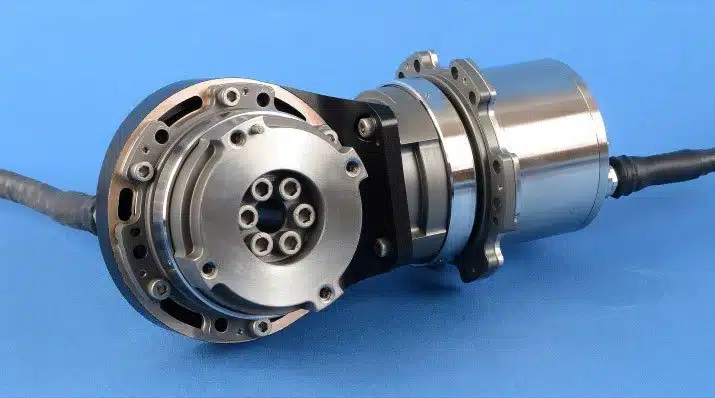
The C14 Bi-Axis Gimbal from Sierra Space is a lightweight, bi-axial gimbal featuring the C14 incremental rotary actuator, developed specifically for critical spacecraft pointing applications. Originally developed for antenna pointing mechanisms on communications satellites, the device has also been adapted for solar array drives and is suitable for thruster or instrument pointing.
Typed specifications36 values
Discloses 4 of 9 fields engineers filter by in this category (category median 2).
- Mass
- 1.23 kg typ. · excluding cables · datasheet p.2 1.23 kg excluding cables | 1.23 kg excluding cables, 2.7 lbm | 1.5 kg including 85 cm of cabling | 1.5 kg typ. · including 85 cm of cabling
- Angular resolution (step)
- 0.063 deg datasheet p.2 0.063 deg step size
- Output torque
- 14 000 mN·m output torque @ 4 degrees/s, 125 in-lb typical at 77 F · datasheet p.2 14 mN·m Output @ 4 degrees/s | 0.9 mN·m Unpowered Holding
- Power consumption
- 10 W Heater (nominal, each) · datasheet p.2 10 W heater power, nominal, each | 10 W nom. · Heater Power, each
- Operating temperature
- -70 °C min · datasheet p.2 70 °C max | -70–70 °C
- Mechanism type
- two-axis gimbal (general purpose) antenna, thruster or instrument pointing, solar array drive · datasheet p.1
- Axes
- 2 bi-axis · datasheet p.1
- Motor type
- stepper motor 2-phase permanent magnet stepper motor · datasheet p.1
- Transmission
- harmonic drive zero-backlash harmonic drive · datasheet p.1
- Max payload inertia
- 1 kg·m² min · maximum inertial load >1 kg-m2 · datasheet p.2
- Holding torque (unpowered)
- 0.9 mN·m unpowered holding torque, 8 in-lb · datasheet p.2
- Survival temperature
- -95 °C min · datasheet p.2 85 °C max | -95–85 °C nonoperating
- Flight heritage
- Eagle (ESPA Augmented Geostationary Laboratory Experiment) datasheet p.2 OrbView 3 and 4 Satellites | Geosynchronous Space Situational Awareness Program (GSSAP) 1, 2, 3, and 4 | Samaritan Satellite
- Slew speed
- 9 °/s at no load · datasheet p.142 9 °/s min · slew rate at no load
- Position feedback
- potentiometer potentiometer for position telemetry · datasheet p.2
- Signal transfer across the joint
- RF rotary joint optional, through hole for RF rotary joints · datasheet p.1 waveguide rotary joint optional, through hole for waveguides | cable wrap through hole used for wire routing
- Launch lock included
- yes optional, upon request · datasheet p.2
Each value is typed with its unit and measurement condition and cites the datasheet page it was taken from. Nothing is guessed: a field that is absent here has not been published by the manufacturer. machine-extracted ✓ checked by NewSpace Market ✓ manufacturer confirmed by the manufacturer.
As published by the supplier20 lines, in the manufacturer's own wording
- Actuator
- C14 Incremental Rotary Actuator
- Applications
- Antenna pointing, solar array drives, thruster/instrument pointing
- Mass
- 1.23 kg, excluding cables
- Mass (2)
- ~1.5 kg including 85 cm of cabling
- Slew Rate
- >9 degrees/s at no load
- Max. Output Acceleration
- 6 degrees/s2
- Output Torque
- 14 nm typical at 77 °F
- Maximum Inertial Load
- >1 kg-m2
- Unpowered Holding Torque
- 0.9 nm
- Actuator Torsional Stiffness
- 3,390 nm/rad
- Axial Load Capacity
- 6,338 N
- Radial Load Capacity
- 1,223 N
- Moment Load Capacity
- 90 nm
- Winding Resistance
- 57 Ω (nominal, 2-phase)
- Winding Inductance
- 30 mH typical
- Torque Constant
- 0.636 nm/A
- Heater Power
- 10 W (nominal, each)
- Potentiometer linearity
- 0.25% over 350 degrees
- Operating Temperature
- -70 °C to 70 °C
- Nonoperating Temperature
- -95 °C to 85 °C
About
The C14 Bi-Axis Gimbal from Sierra Space is a lightweight, bi-axial gimbal featuring the C14 incremental rotary actuator, developed specifically for critical spacecraft pointing applications. Originally developed for antenna pointing mechanisms on communications satellites, the device has also been adapted for solar array drives and is suitable for thruster or instrument pointing.
Documentation
Need the full ICD, test reports or a specific revision? Ask the supplier directly.