Dynamic Spectrum Environment Emulator (DYSE®)
 Parsons Space
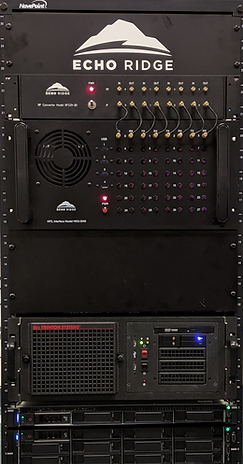
DYSE® is an RF channel emulator that simulates realistic RF environments, including congested and contested conditions, for testing and evaluation of RF systems.
Technical specifications
- Tuning range
- up to 20 GHz
- Ibw
- >1 GHz
- Path delay
- >1 sec
- RF paths
- Up to 1024
- Interconnection
- Full-mesh
- Dyse® agile real time mode per-channel ibw
- up to 25 MHz
- Dyse® agile tuning range
- 10Mhz – 6 GHz
- Dyse® cyber ibw per-channel
- GHz
- Dyse® connect tuning range
- up to 20 GHz
- Dyse® connect per-channel ibw
- scalable to 1 GHz and higher
- Dyse® connect matrix
- Can scale up to 32×32
- Dyse® connect paths
- 1024
- Ibw per-channel
- >1 GHz
- Tuning range (2)
- 10 MHz to 20 GHz
- Propagation delay
- >1 sec
About
The Dynamic Spectrum Environment Emulator (DYSE®) is an RF channel emulator designed to imitate realistic RF environments, including congested and contested conditions. It allows for individually programmable RF paths and emulates the impact of real-world operational conditions in a lab environment. DYSE® supports the full RF Systems Development Life Cycle, from RF Modeling and Simulation (M&S) to Testing and Evaluation (T&E). It enables emulation of realistic RF environments, RF Digital Twin performance testing, and RF Virtual Reality creation. The system provides high-fidelity, repeatable RF systems testing with real-world field quality characteristics and is optimized for modern RF technology like SDRs. It is scalable to support various user capacity needs, from small to massive RF scenarios, and accelerates RF development and time-to-field. DYSE® supports both Virtual Nodes (VSUs: virtual models of systems) and Physical Nodes (PSUs: real systems that can be connected for test and simulation). It has been tested for applications such as 5G, Spectrum sharing, Resilient PNT, Cognitive Radio, Tactical and LPI/LPD communications systems, and EW systems. RF devices under test interconnect through synthetically generated RF environments, with paths emulating real-world RF operational conditions and being individually programmable. Physical devices can interact with virtual devices through full-mesh interconnection, with interactions taking place through the DYSE® Virtual RF Environment (VRE) at digital baseband. RF Hardware-in-the-Loop (HiTL) interfaces provide analog RF connections for physical devices. DYSE® can be used to develop and refine RF designs, concepts, applications, and algorithms by passing data from RF device models through mathematical and statistical channel models to predict performance. It is available in configurations for M&S and T&E, providing a versatile platform for accelerating RF systems development and reducing risk. Users can create test scenarios with physical and virtual nodes, placed on terrestrial, airborne, or space platforms with associated antenna patterns and 6 DOF motion. The emulator models RF propagation paths, introducing effects like Path Loss, Fading, Multipath, Shadowing, Propagation Delay, Doppler, and Nuclear Scintillation. It offers full-mesh node interconnection, independent RF parameters for each path, and dynamic path modeling. DYSE® is available in several configurations: DYSE® Desktop for non-real-time M&S on a laptop/desktop; DYSE® Agile for M&S and limited T&E with higher processing power and optional HiTL; DYSE® Cyber for high-capacity M&S with virtual nodes; and DYSE® Connect for lab-based T&E with physical and virtual nodes, real-time execution, and scalable channel capacity.
Documentation
No public datasheet yet — request the datasheet / ICD from the supplier.