FIREBIRD-II CubeSat
 Montana State University
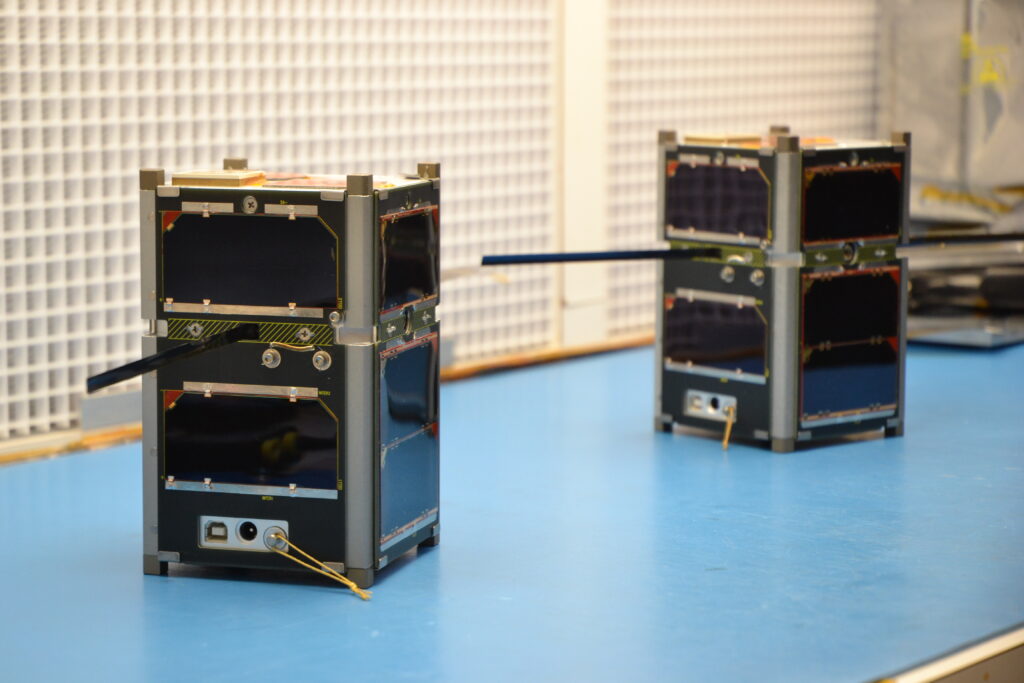
1.5U space-weather CubeSat pair built by Montana State University and University of New Hampshire to study relativistic electron microbursts in the Van Allen belts.
Key figurescomparable across the catalogue
- Mass
- 2 kg
- Largest dimension
- 150 mm
Normalised to common units so this product can be compared with others in its category. The supplier's own wording is below.
As published by the supplier
- Form factor
- 1.5U CubeSat (pair)
- Dimensions
- 10 x 10 x 15 cm
- Mass
- Up to 2 kg per satellite
- Orbit
- Low Earth orbit, ~470-820 km, sun-synchronous
- Launch date
- 2013 (FIREBIRD); 2015 (FIREBIRD-II)
- Attitude control
- Passive magnetic stabilization
- Payload
- Dual solid-state energetic electron detectors, 0.25-1 MeV, 6 channels
About
FIREBIRD (Focused Investigations of Relativistic Electron Burst Intensity, Range, and Dynamics) is a space-weather CubeSat mission developed by Montana State University’s Space Science and Engineering Laboratory (SSEL) in partnership with the University of New Hampshire, funded by NASA and the National Science Foundation. The mission flew as two nearly identical satellite pairs: FIREBIRD (launched 2013) and the operational FIREBIRD-II pair (launched 2015), designed to fly in tandem to resolve the spatial scale size of electron microburst precipitation events in Earth’s Van Allen radiation belts.
Each FIREBIRD spacecraft is a 1.5U CubeSat (10 x 10 x 15 cm) with a total mass of up to 2 kg. The upper half-unit houses the FIRE sensor payload, an energetic particle detector developed by the University of New Hampshire, while the lower 1U section is the BIRD spacecraft bus, built by Montana State University’s SSEL, providing power, attitude control, command and data handling, and communications. Each satellite carries two solid-state detectors covering electron energies from roughly 0.25 to 1 MeV across six differential energy channels, read out by a custom Dual Amplifier Pulse Peak Energy Rundown ASIC designed by The Aerospace Corporation. Attitude is controlled passively using permanent magnets.
Flying as a closely spaced pair in low Earth orbit, the FIREBIRD-II satellites made correlated, multi-point measurements that resolved microburst spatial scales for the first time, contributing significant new understanding of radiation belt electron loss mechanisms and space weather dynamics relevant to spacecraft operations.
Documentation
No public datasheet yet — request the datasheet / ICD from the supplier.