Shockwave
 iRocket
Fully autonomous, two-stage, 100%-reusable launch vehicle targeting 300-1,500 kg payloads to LEO/GEO with 24-hour turnaround.
Key figurescomparable across the catalogue
- Payload capacity
- 1,500 kg
Normalised to common units so this product can be compared with others in its category. The supplier's own wording is below.
As published by the supplier
- Configuration
- Two-stage-to-orbit, vertical takeoff / vertical landing (VTVL)
- Height
- ~125 ft (~38 m)
- Diameter
- 9 ft (~2.7 m)
- Payload capacity
- 300-1,500 kg to LEO
- Target orbits
- LEO, GEO, translunar
- Propellant
- Liquid oxygen (LOX) / liquid methane
- Engine thrust (test)
- ~35,000 lbf reusable engine, static-fire tested 120-180 s
- Reusability
- 100% — both stages and fairing designed for recovery and reuse
- Turnaround target
- 24 hours
- Launch site
- Inland-capable; planned from Launch Complex 48, Cape Canaveral, FL
About
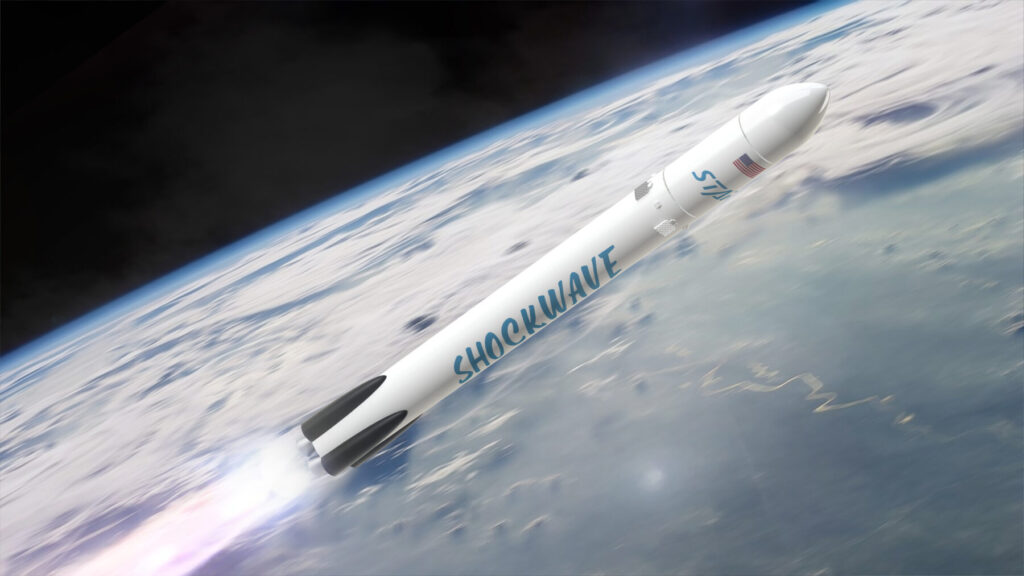
Shockwave is iRocket’s flagship orbital launch vehicle: a fully autonomous, two-stage-to-orbit rocket designed from the outset for complete reusability of both stages, including the fairing. The vehicle stands approximately 125 feet tall with a 9-foot diameter and uses a vertical takeoff, vertical landing (VTVL) configuration that enables inland launch sites rather than requiring a coastal launch complex.
The vehicle is powered by iRocket’s proprietary reusable engine technology burning liquid oxygen (LOX) and liquid methane — a clean-burning combination chosen because it leaves minimal residue and buildup, easing rapid engine reuse in a manner the company compares to a jet engine’s maintenance cycle. The engine has been demonstrated in augmented, unaugmented and landing operating modes, and is rated at roughly 35,000 lbs of thrust per unit in its Space Force-funded test campaign. iRocket is maturing the engine and stage technology in partnership with the Air Force Research Laboratory at the High Thrust Research Facility, Edwards Air Force Base — one of only four U.S. test stands capable of 10 million lbs of thrust.
Shockwave targets 300 to 1,500 kg payloads to low Earth orbit, geostationary orbit and translunar destinations, serving small/medium satellite constellations, national security payloads, and cargo delivery missions. iRocket’s stated goal is a 24-hour ‘Recondition, Reload, and Relaunch’ turnaround between flights, with both booster and upper stage designed to land back at or near the launch site for immediate refurbishment. The company has targeted a first flight in the late-2020s and has secured government funding (AFWERX SBIR, TACFI, CRADA) and a large commercial launch agreement with SpaceBelt KSA to support the vehicle’s development.
Documentation
No public datasheet yet — request the datasheet / ICD from the supplier.