IVO Quantum Drive
 IVO Limited
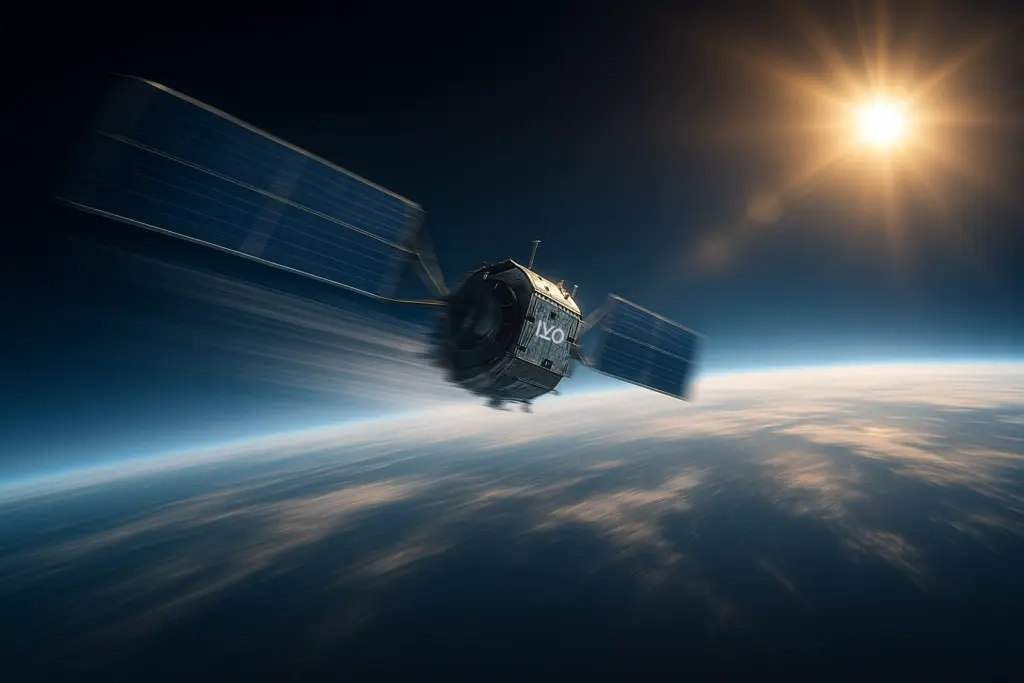
Pure electric satellite thruster requiring zero propellant, based on asymmetric capacitive technology drawing on principles of Quantized Inertia.
Typed specifications4 values
Discloses 2 of 10 fields engineers filter by in this category (category median 3).
- Thrust
- 45–52 mN product page
- Propellant
- other propellantless (no propellant) · product page
- Power consumption
- 1 W product page
- Operating temperature
- -100 °C product page
Each value is typed with its unit and measurement condition and cites the datasheet page it was taken from. Nothing is guessed: a field that is absent here has not been published by the manufacturer. machine-extracted ✓ checked by NewSpace Market ✓ manufacturer confirmed by the manufacturer.
As published by the supplier12 lines, in the manufacturer's own wording
- Claimed thrust per unit
- 45–52 mN
- Power consumption
- 1 W per unit
- Propellant
- None (zero fuel)
- Mass per unit
- ~300 g
- Scalability
- Stackable modular units
- Degrees of freedom
- Up to 6 (any-orientation mounting)
- Vacuum test level
- 9e-6 Torr
- Operating temperature (tested)
- -100°C to +100°C
- Power source
- Solar-harvested electricity
- Installation
- Internal spacecraft mounting
- Propulsion principle
- Asymmetric capacitive / Quantized Inertia (QI/MiHsC)
- First orbital test
- 10 June 2023 (SpaceX Transporter 8, OTP-2 satellite)
About
The IVO Quantum Drive is a propulsion device for satellites that operates entirely on electrical power with no chemical propellant, pressurized tanks, or exhaust emissions. It uses asymmetric capacitors with microscopic plate gaps filled with a dielectric material; when high-voltage charge is applied, accelerated electrons create an asymmetric reaction force claimed to generate thrust based on the principles of Quantized Inertia (QI/MiHsC).
The thruster is modular and stackable: multiple units can be combined to multiply thrust output, and each unit can be mounted in any orientation, enabling up to six degrees of freedom for spacecraft maneuvering. The system is fully self-contained and can be installed internally within a satellite chassis, eliminating the need for external nozzle clearances. IVO claims performance of approximately 52 millinewtons of thrust per watt of power during thermal vacuum testing, validated by E-Labs of Fredericksburg, Virginia at 9×10^-6 Torr and temperatures from -100°C to +100°C.
The Quantum Drive flew its first orbital demonstration aboard the OTP-2 satellite (Rogue Space Systems) launched on SpaceX Transporter 8 on June 10, 2023. The technology remains scientifically controversial as quantized inertia is not yet mainstream consensus physics, and independent orbital thrust confirmation has not been publicly released.
Documentation
No public datasheet yet — request the datasheet / ICD from the supplier.