SELENE / Kaguya Lunar Orbiter
 JAXA - Japan Aerospace Exploration Agency
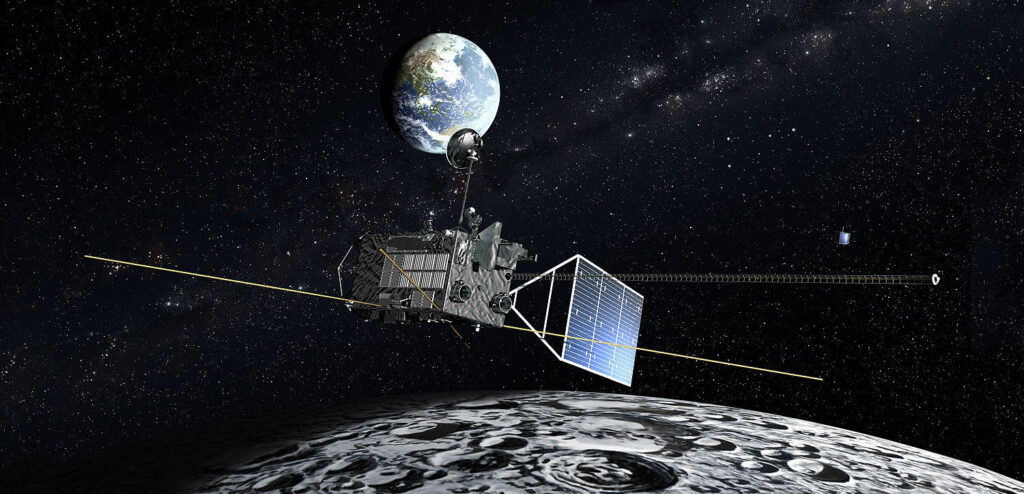
SELENE (Selenological and Engineering Explorer), nicknamed Kaguya after the Japanese lunar princess from folklore, was JAXA comprehensive lunar orbiter mission launched on September 14, 2007, using an H-IIA rocket. The mission consisted of a main spacecraft in a 100-km polar orbit around the Moon, plus two small sub-satellites (the Relay Satellite and the VRAD Satellite) […]
Technical specifications
- Launch date
- September 14, 2007
- Main orbiter mass
- 3000
- Dimensions
- 2.1 x 2.1 x 4.8
- Orbit altitude
- 100
- Inclination
- 90
- Number of instruments
- 15
- Mission end
- June 10, 2009
About
SELENE (Selenological and Engineering Explorer), nicknamed Kaguya after the Japanese lunar princess from folklore, was JAXA comprehensive lunar orbiter mission launched on September 14, 2007, using an H-IIA rocket. The mission consisted of a main spacecraft in a 100-km polar orbit around the Moon, plus two small sub-satellites (the Relay Satellite and the VRAD Satellite) deployed into elliptical orbits for radio observations. Kaguya carried 15 scientific instruments, including a terrain camera producing the highest-resolution global lunar topographic data at the time, a gamma-ray spectrometer, a lunar radar sounder, a magnetometer, a laser altimeter, and a high-definition television camera that produced breathtaking HD footage of the lunar surface and Earth rising above the lunar horizon. The mission operated until June 2009 when it was deliberately impacted on the lunar surface. Kaguya yielded over 10 terabytes of scientific data and produced the most detailed global map of the Moon achieved to that date, revolutionizing understanding of the Moon geology, composition, and origin.
Documentation
No public datasheet yet — request the datasheet / ICD from the supplier.