High Frontier Mission 1
 Karman+
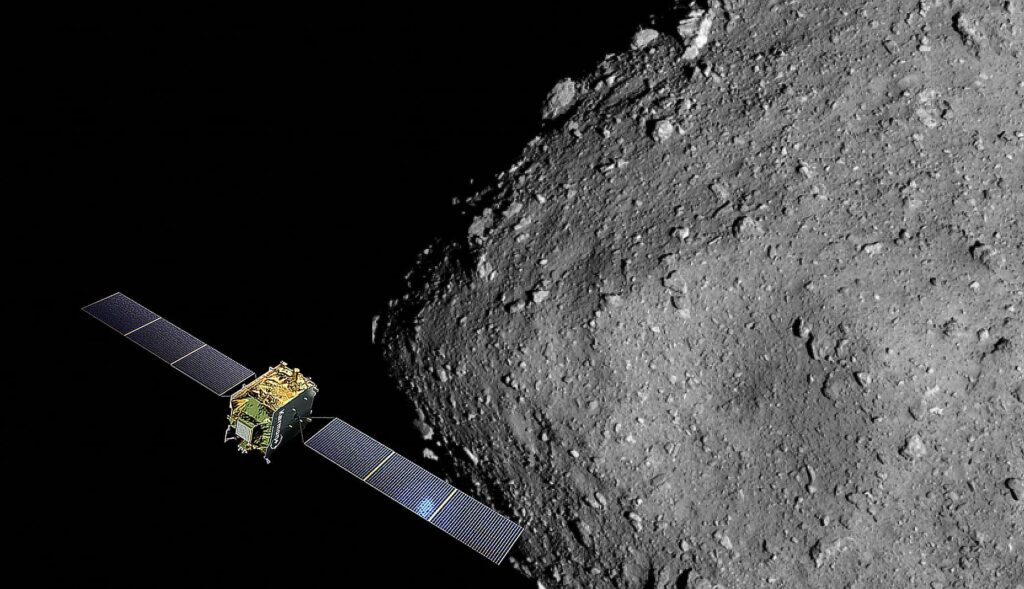
Karman+'s inaugural autonomous spacecraft mission to rendezvous with a near-Earth asteroid and demonstrate kilogram-scale regolith capture.
Technical specifications
- Mission type
- Near-Earth asteroid rendezvous and regolith capture
- Launch vehicle
- SpaceX Transporter 19 (rideshare)
- Planned launch
- Early 2027
- Propulsion
- Solar electric propulsion (SEP)
- Navigation
- Autonomous optical navigation
- Target asteroid class
- C-type rubble-pile near-Earth asteroid
- Regolith capture scale
- Kilogram-scale demonstration
- Interaction method
- Touch-and-go (TAG)
- Spacecraft mass class
- Under 1,000 kg
- Delta-v capability
- ~7 km/s
About
High Frontier Mission 1 is Karman+’s inaugural autonomous spacecraft designed to rendezvous with an uncharacterized near-Earth asteroid and demonstrate regolith capture at kilogram scale, while minimizing mission duration and cost.
The spacecraft employs solar electric propulsion (SEP) and autonomous optical navigation — avoiding the expense of ground-based remote piloting — along with modified off-the-shelf hardware to dramatically reduce mission cost compared to traditional space agency approaches. The mission architecture uses a touch-and-go (TAG) interaction method, similar to NASA’s OSIRIS-REx and JAXA’s Hayabusa2, adapted for C-type rubble-pile asteroid surfaces.
Target selection is managed via Karman+’s proprietary asteroid leaderboard, which ranks hundreds of near-Earth asteroids by reachability (flexible launch windows and delta-v margins), excavation feasibility (size, rotation rate, surface stability), and scientific value (spectral profile). Asteroids rotating slower than the 2.2-hour spin barrier — indicating loosely consolidated rubble-pile structures — are prioritized for grappling arm interaction.
The spacecraft is being developed through an iterative Design-Build-Test-Break-Redesign cycle. Full-scale engineering models have undergone rapid iteration and first flight models are being assembled. Launch is planned for early 2027 aboard a SpaceX Transporter 19 rideshare mission.
Documentation
No public datasheet yet — request the datasheet / ICD from the supplier.