MROI – Magdalena Ridge Observatory Interferometer
 EIE Space Technologies Srl
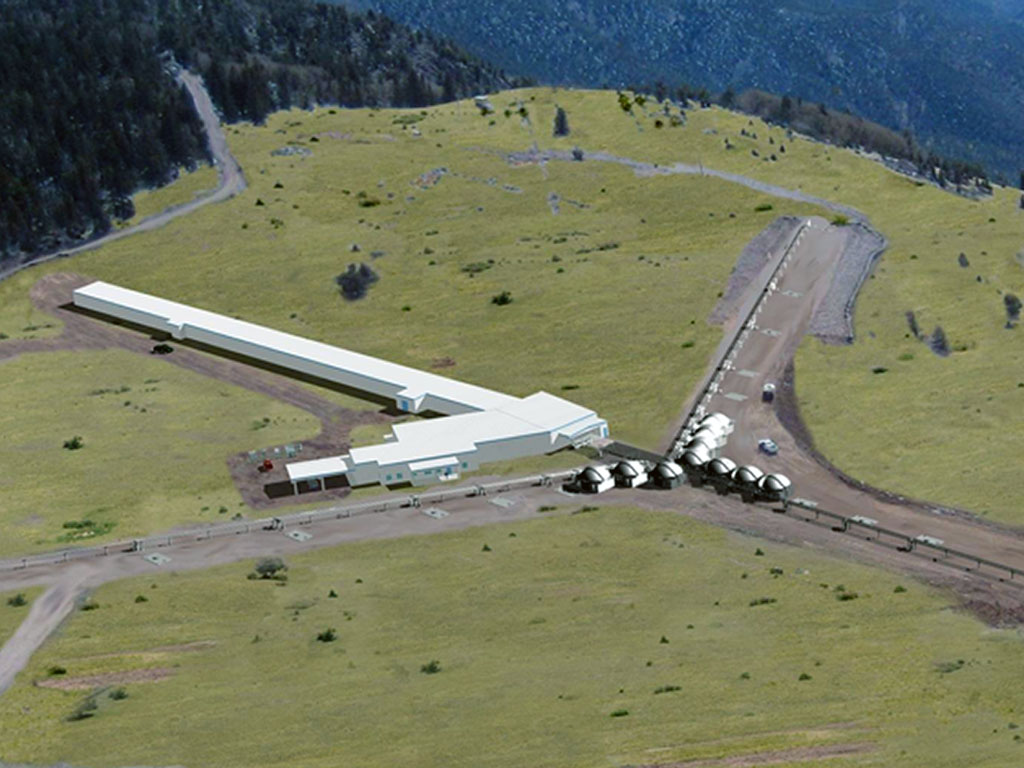
The Magdalena Ridge Observatory Interferometer (MROI) is an optical-infrared interferometer composed of 10 elements, currently under construction in New Mexico, USA.
Technical specifications
- Site
- New Mexico, Magdalena Mountains, Cibola National Forest, Socorro County USA
- State
- Under Construction
- Data
- 2015-2024
- Cliente
- New Mexico Institute of Mining and Technology (NMT)
- Telescope Diameter
- 1.4m (each of 10 telescopes)
- Array Configuration
- Y-shaped
- Baseline Range
- 7.8 to 340 meters
- Wavelength Range
- 0.6 to 2.5 microns
About
The Magdalena Ridge Observatory (MRO) is an educational and research astronomical observatory located in the Magdalena Mountains of the Cibola National Forest. It is the result of a scientific collaboration between the New Mexico Institute of Mining and Technology (New Mexico Tech – NMT) and the Cavendish Astrophysics Group of the University of Cambridge. MRO consists of two main structures: an operational 2.4m telescope and the Magdalena Ridge Observatory Interferometer (MROI), an optical-infrared interferometer composed of 10 elements, which is now under construction.
Upon completion, it will consist of 10 telescopes, each 1.4m, located on three 340m arms. Each arm will have nine stations where instruments can be positioned, while an additional telescope can be placed at the center of the “intersection.” The telescopes and their enclosures can be moved using a crane specially created for the purpose. EIE GROUP has been involved with the MROI project since 2008, undertaking the Detailed Design of the observatory’s second-largest structure, the 10-element optical/infrared interferometer. The MROI will have an array of 10 repositionable 1.4m telescopes arranged in a “Y” configuration. Each will be housed within a Unit Telescope Enclosure (UTE), which can be raised and moved to any of the 28 planned stations via a dedicated relocation system.
The lower part of the UTE will be a rectangular steel structure, strong enough to support the telescope mount’s weight during relocation. The external covering will consist of infill panels, designed to protect the instruments from atmospheric conditions and provide thermal insulation. Both the dome (the rotating upper part) and the shutter will be self-supporting composite structures (GFRP for the former, CFRP for the latter). These materials will ensure adequate thermal and environmental protection, compactness, structural stability, and limited energy consumption due to reduced mass, differentiating MROI’s UTEs from all other conventional enclosures. The shutter and dome will be different mechanisms. During observations, the shutter flips back relative to the dome to expose the observational aperture, allowing their combined movement to cover the telescope’s observational range. This solution will greatly simplify the dome system, which, without mechanisms and auxiliary systems, becomes a simple rotating cover.
Documentation
No public datasheet yet — request the datasheet / ICD from the supplier.