NEE-02 KRYSAOR
 EXA (Ecuadorian Space Agency)
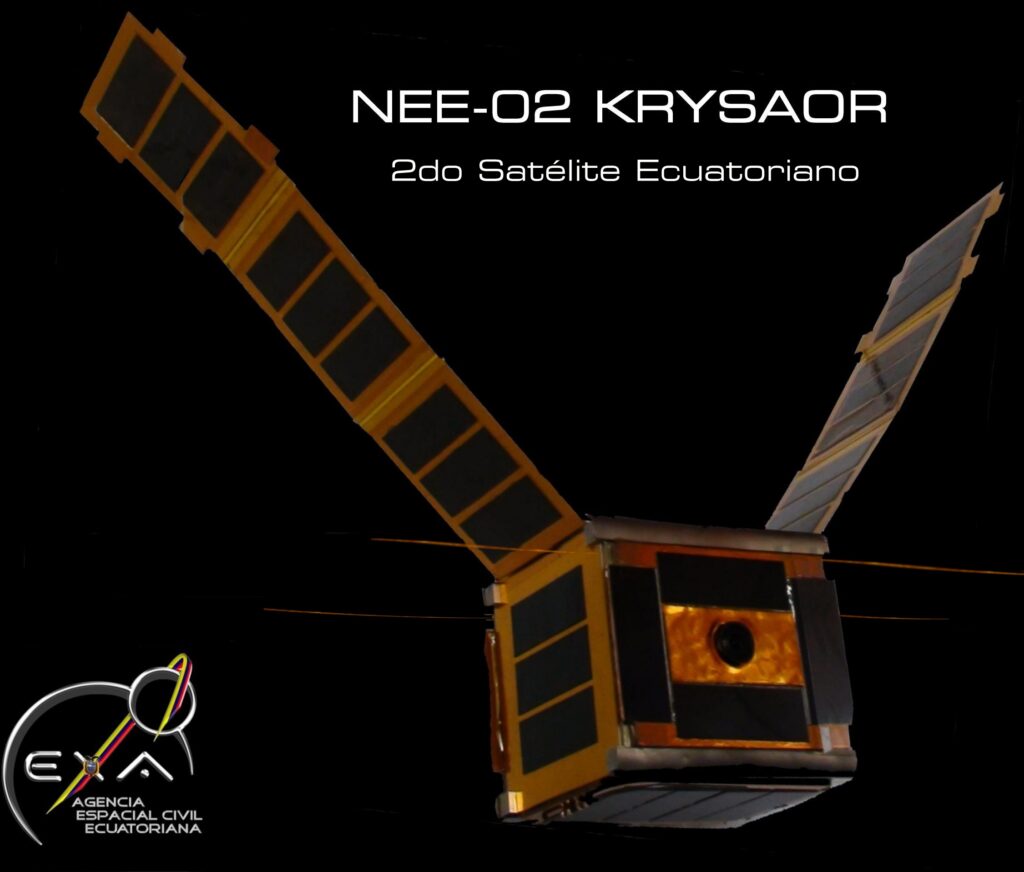
The NEE-02 KRYSAOR is the second Ecuadorian satellite, a twin to NEE-01 PEGASO, primarily serving as an orbital repeater for the NEE-01 signal.
Technical specifications
- Orbit Type
- Elliptical Heliosynchronous
- Inclination
- 97.7 degrees
- Perigee
- 598 km
- Apogee
- 720 km
- Launch Date
- November 21, 2013
- Expected Re-entry
- 2025
About
The NEE-02 KRYSAOR is a PEGASO-class satellite, meaning it is a twin to the NEE-01 and was built after it. Its main current function is to serve as an orbital repeater to receive the signal from NEE-01 PEGASO. The NEE-02 was injected into an elliptical heliosynchronous orbit at 97.7 degrees inclination, with a perigee of 598 km and an apogee of 720 km on November 21, 2013. On January 25, 2014, the NEE-02 regained access to the NEE-01 signal in an unprecedented operation using the PERSEO repetition module. The NEE-02 KRYSAOR carries a micro-repeater and special antennas mounted on its wings, which together form the PERSEO module. Currently, the NEE-02 retransmits the NEE-01 signal whenever they fly in parallel within a maximum range of 3000kms at 650 km altitude. The mission of NEE-02 is the same as PEGASO, fulfilling orbital sentinel functions to monitor potential threats from near-Earth objects in their final approach phase and control orbital debris. Additionally, it incorporates new advancements in active deployment of its solar panels, high-speed digital transmission, and a camera with higher resolution than PEGASO. On November 21, 2014, the NEE-02 KRYSAOR completed its one-year mission in orbit and remains operational, with its re-entry expected in 2025.
Documentation
No public datasheet yet — request the datasheet / ICD from the supplier.