NewSpace Compact Master Reference Oscillator
 Rakon Limited
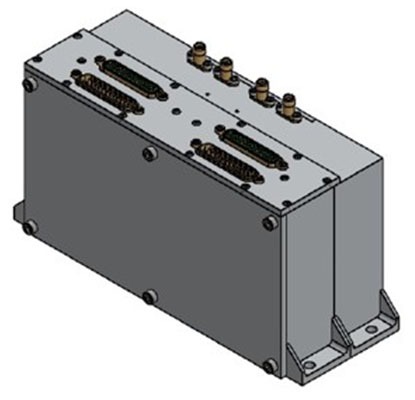
A compact Master Reference Oscillator (MRO) designed for NewSpace constellations, generating and distributing highly stable and reliable frequency signals for telecommunications, navigation, and earth observation applications.
Key figurescomparable across the catalogue
- Power
- 9 W
- Design life
- 12 years
Normalised to common units so this product can be compared with others in its category. The supplier's own wording is below.
As published by the supplier
- Output frequency
- 100 MHz/200 MHz
- Overall frequency stability (2 years)
- ±50 ppb
- Overall frequency stability (12 years)
- ±200 ppb
- Output power
- 9 dBm
- Typical phase noise @100 mhz (@10 Hz)
- -100 dBc/Hz
- Typical phase noise @100 mhz (@100 Hz)
- -125 dBc/Hz
- Typical phase noise @100 mhz (@1 kHz)
- -150 dBc/Hz
- Typical phase noise @100 mhz (@floor)
- -165 dBc/Hz
- Outputs
- 2x 200 MHz + 2x 100 MHz
- Power bus
- 28 V
- Communication interface
- CAN
- Pps
- 2x inputs + 2x outputs (RS422)
- Power consumption (typical)
- 9 – 11 W
- Frequency connectors
- SMA
- Power & tm/tc connectors
- SubD
- Nominal frequency
- 100 MHz
- Supply voltage
- 24 V - 34 V
- Frequency stability over temperature
- ±1.5 ppb
- Overall frequency drift (After 2 years)
- ±50 ppb
- Overall frequency drift (After 12 years)
- ±200 ppb
- Holdover (48 hours)
- ±2 ppb
- Short-term stability (ADEV @1s)
- 1E-12
- Short-term stability (ADEV @10s)
- 1E-12
- Short-term stability (ADEV @100s)
- 1E-12
- Short-term stability (ADEV @1000s)
- 5E-12
- Output waveform (100 MHz)
- Sine
- Output power level (100 MHz)
- +9 dBm
- Harmonics level (100 MHz)
- -30 dBc
- Spurious level (100 MHz)
- -100 dBc
- Phase noise @ 100 mhz output (10 Hz offset)
- -100 dBc/Hz
- Phase noise @ 100 mhz output (100 Hz offset)
- -125 dBc/Hz
- Phase noise @ 100 mhz output (1 kHz offset)
- -150 dBc/Hz
- Phase noise @ 100 mhz output (10 kHz offset)
- -165 dBc/Hz
- Output waveform (200 MHz)
- Sine
- Output power level (200 MHz)
- +12 dBm
- Harmonics level (200 MHz)
- -30 dBc
- Spurious level (200 MHz)
- -100 dBc
- Phase noise @ 200 mhz output (10 Hz offset)
- -95 dBc/Hz
- Phase noise @ 200 mhz output (100 Hz offset)
- -120 dBc/Hz
- Phase noise @ 200 mhz output (1 kHz offset)
- -145 dBc/Hz
- Phase noise @ 200 mhz output (10 kHz offset)
- -160 dBc/Hz
- Operating acceptance temperature
- -15 °C to 60 °C
- Non-operating temperature (Qualification)
- -35 °C to 85 °C
- Random vibration (Out of plane)
- Overall level = 20.16 gRMS
- Random vibration (In Plane)
- Overall level = 12.2 gRMS
- Sine vibration (X, Y and Z axes)
- 5 – 21 Hz: ±6.8 mm; 21 – 100 Hz: ±20 g
- Mechanical shock (SRC – Q = 10, X, Y and Z axes)
- 100 Hz: 30 g; 1000 Hz: 1100 g; 10000 Hz: 1100 g
- Radiation
- Up to 50 krads
- Design life
- Up to 12 years
- Package (X x Y x Z)
- 216 x 108 x 118 mm
- Power consumption (Cold redundancy, Typical)
- 9.2 W
- Power consumption (Cold redundancy, Max)
- 10.2 W
- Power consumption (Warm-up)
- 20.7 W
About
The NewSpace Master Reference Oscillator (MRO) is a Space Subsystem that generates and distributes highly stable and reliable frequency signals. It is suitable for LEO, MEO, and small GEO satellites with a lifetime up to 12 years. The MRO is specifically designed for telecommunications, navigation, and earth observation applications where frequency stability, ultra-low phase noise, and low power consumption are crucial. It provides up to 4 outputs with highly stable frequencies at 100 and 200 MHz, generated from an ultra-stable oscillator. The MRO achieves a long-term stability of ±200 ppb over a 12-year lifetime. Short-term stability is ensured by the intrinsic OCXO performance, and long-term stability is guaranteed by a microcontroller that disciplines the oscillator on a GNSS PPS signal. Advanced algorithms ensure smooth synchronization while avoiding glitches or jumps in the frequency. The subsystem is Single Point Failure (SPF) free, with nominal and redundant functions fully isolated. It can be used in cold and hot redundancy. The MRO includes a DC/DC converter, On/Off telecommands, PPS input/outputs via RS422, a CAN communication bus, and all necessary telemetry for reliable monitoring and operation. It is based on a modular architecture for ease of assembly, integration, and customization. Product quality adheres to the highest industry standards, with components chosen according to AECQ-100/200 criteria and active components undergoing radiation testing for every lot. This compact MRO is an ideal solution for lightweight devices with a small footprint.
Documentation
No public datasheet yet — request the datasheet / ICD from the supplier.