Printer Assisted Deployment System (PADS)
 Orbital Matter
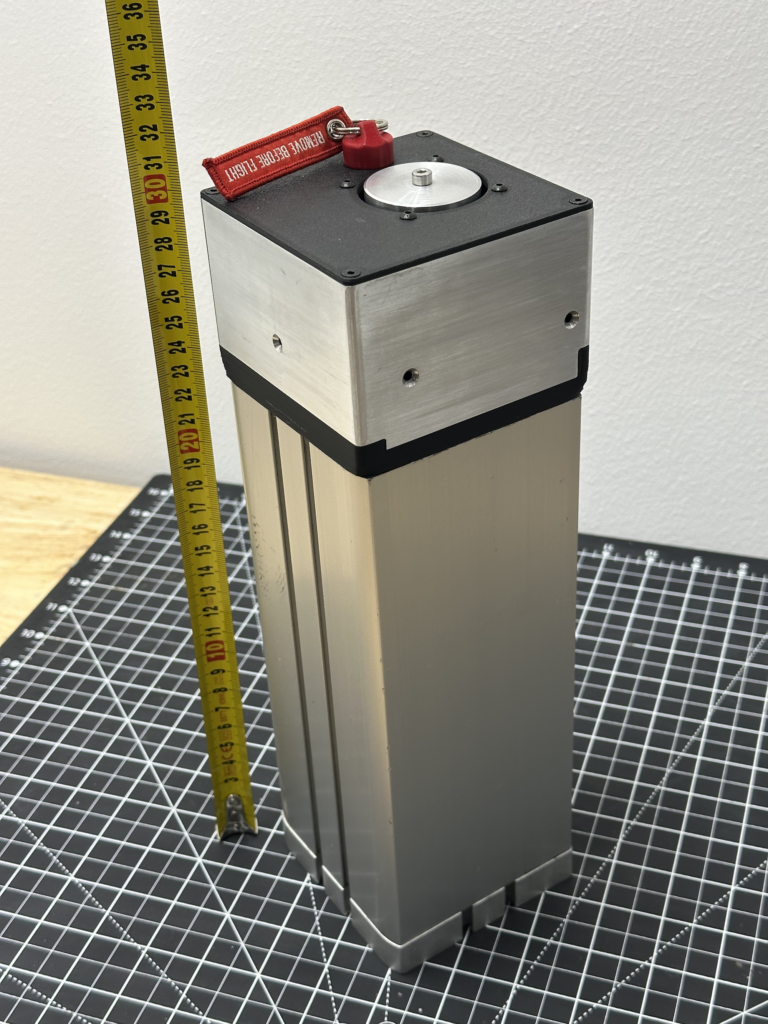
PADS is a plug-and-play in-orbit manufacturing unit that produces rigid, continuous structural booms from 10 to over 100 meters for satellite deployables like solar arrays, radiators, and antennas.
Technical specifications
- Boom length
- 10 meters to over 100 meters
- Boom diameter
- Adjustable between 38 mm and 90 mm
- Power draw during deployment
- Less than a standard light bulb
- Flight heritage
- Flight qualification tests passed, launching on multiple missions in 2026 with ESA and Thales Alenia Space
About
The Printer Assisted Deployment System (PADS) is an innovative in-orbit manufacturing unit designed to create large structural elements directly in space, overcoming the limitations of launch fairing sizes. It operates on a principle similar to concrete on Earth, using photopolymer resin and UV light for on-site curing. The system stores photopolymer resin as a fluid, which is then extruded through a precision head, forming the structure profile layer by layer. A precisely tuned UV light source rapidly hardens the resin as it is extruded, a process that requires very low power, comparable to a light bulb, and avoids the thermal complexity of melt-based additive manufacturing. The result is a continuous, rigid, and dimensionally stable structure free of joints or mechanical connections. The size of the structure is limited only by the amount of raw material carried.
The PADS system is designed to be material-agnostic, validated with both photopolymer resin and thermoplastic feedstock. The baseline material for space applications is an aerospace-rated photopolymer optimized for vacuum performance, low outgassing, and radiation resistance. It integrates with most satellite platforms, providing a standardized deployment interface for various payloads requiring long, stable booms that cannot be folded and launched conventionally. The system feeds stored structural material through a controlled deployment mechanism that shapes, stabilizes, and locks it into a rigid profile during exit, all autonomously in orbit. Key capabilities include a peak power draw during deployment of less than a standard light bulb, configurable boom cross-sections between 38mm and 90mm, operation as a closed system with zero debris release, and maintained electrical connection between the boom end and satellite base throughout deployment for power and data transfer. An optional payload retraction and reentry capability allows the payload to be retracted back into the module for reentry scenarios or repositioning.
PADS has passed all flight qualification tests and is scheduled for launch on multiple missions in 2026 with ESA and Thales Alenia Space. Future roadmap plans include kilometer-scale solar arrays and radiators by 2028 and on-demand construction of various geometries for space stations, data centers, and lunar infrastructure by 2030+.
Documentation
No public datasheet yet — request the datasheet / ICD from the supplier.