OrbitIQ
 Arcfield (formerly Orion Space Solutions)
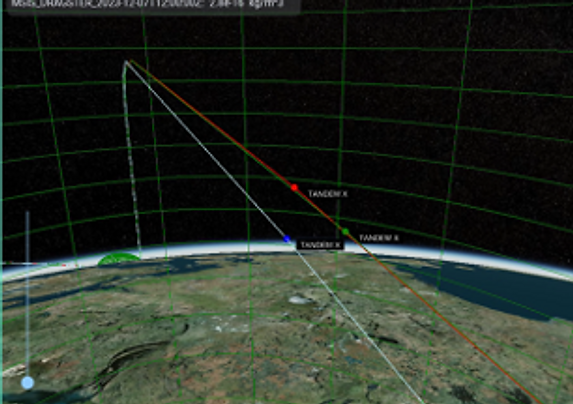
OrbitIQ is a cloud-native orbital modeling platform that improves space domain awareness by reducing orbital uncertainty and false collision alarms for satellite operators.
Technical specifications
- Orbital uncertainty reduction
- From 50 km to less than 5 km per object
- Daily collision warnings processed
- 10,000+ potential collision warnings, ~90% false alarms
- Architecture
- Cloud-native, built on AWS
- Export/classification status
- First unclassified, export-authorized space domain awareness solution
- Core components
- Dragster (real-time physics-based drag modeling), AstroLabe (cloud-native covariance engine across six degrees of freedom), 4DEnVar (Four-Dimensional Ensemble Variational Assimilation)
- Environment modeling
- Digital twin modeling thermosphere, ionosphere, and satellite interactions
- Positional accuracy
- 5 km or less
About
OrbitIQ is Arcfield’s orbital modeling platform built to transform space traffic coordination and space domain awareness (SDA) in the congested low Earth orbit (LEO) environment. Operators currently sift through 10,000+ potential collision warnings daily, of which roughly 90% are false alarms; OrbitIQ reduces these false alarms and delivers validated predictions for more informed decision-making. It reduces orbital uncertainty from 50 kilometers to less than 5 kilometers per object through precision orbital modeling, and is described as the first unclassified, export-authorized SDA solution, deployed via a secure, cloud-native architecture (built on AWS) for anywhere/anytime access. OrbitIQ leverages a comprehensive, dynamic digital twin of the space environment, modeling interactions between the thermosphere, ionosphere, and satellites to provide a holistic understanding of current conditions, precise forecasting of future conditions and trajectories, and the ability to simulate and analyze complex operational scenarios. The OrbitIQ ecosystem integrates three proprietary technologies: Dragster (real-time physics-based drag modeling that dynamically adapts predictions to actual atmospheric conditions), AstroLabe (a cloud-native engine producing realistic covariance models across all six degrees of freedom), and Four-Dimensional Ensemble Variational Assimilation (4DEnVar), which provides real-time updates to the orbital environment using current thermosphere measurements. Stated operational advantages include improved fuel efficiency by reducing unnecessary maneuvers and extending satellite lifespans, increased operational confidence through quantified uncertainty for faster data-driven decisions, resilience against solar storms with rapid recovery during geomagnetic disruptions, and enhanced spacepower by preventing adversaries from leveraging camouflage or deception tactics. OrbitIQ is positioned to support emerging mission demands in very low Earth orbit (VLEO) and cislunar space, mitigate growing threats from debris and adversarial strategies, and support allied coordination and transparency for long-term orbital sustainability.
Documentation
Need the full ICD, test reports or a specific revision? Ask the supplier directly.