IONOSPHERIC SENSORS (TRIDENT, OSIRIS, RIO)
 Arcfield (formerly Orion Space Solutions)
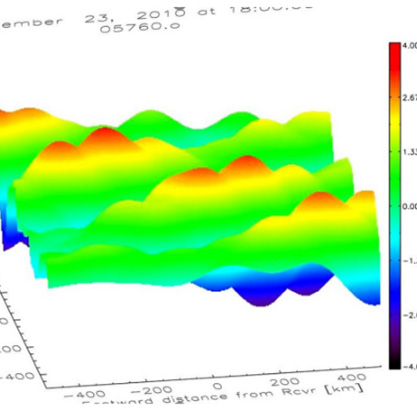
Orion's ionospheric sensors provide advanced monitoring and analysis of the ionosphere, delivering real-time data for satellite communications, navigation, and scientific research. The product line includes TRIDENT (Doppler radar for TIDs), OSIRIS (ocean-stabilized remote imaging sensor), and RIO (d
Technical specifications
- Receiver type
- Software-based, dual-frequency GPS receiver
- Primary application
- Ionospheric disturbance / space weather characterization
- Impact areas monitored
- Power grids, GPS position/timing accuracy, tactical communications
About
Orion’s ionospheric sensors offer advanced monitoring and analysis capabilities with exceptional accuracy, providing real-time data crucial for enhancing satellite communications, navigation, and scientific research. These sensors are designed for diverse applications including defense, space operations, and atmospheric research, ensuring actionable intelligence from various platforms.
TRIDENT is a unique Doppler radar system specifically designed to observe and measure the propagation properties of traveling ionospheric disturbances (TIDs). It can capture data of gravity waves originating from rapidly moving point sources, such as hypersonic objects, in near-real-time. The system utilizes a network of synchronized receivers spread across wide geographic areas to triangulate and track ionospheric perturbations with high temporal and spatial resolution. Its advanced signal processing algorithms are capable of differentiating between natural and artificial sources of ionospheric disturbances, making it valuable for both scientific research and surveillance applications.
The Ocean Stabilized Ionospheric Remote Imaging Sensor (OSIRIS) leverages Orion’s advanced ionospheric sensing technology to collect high-resolution space physics data from mobile and moored ocean platforms. Engineered to withstand the harsh marine environment, OSIRIS enables continuous and precise monitoring of ionospheric activity over remote and dynamic ocean regions. By providing insights into space weather and ionospheric disturbances, OSIRIS helps scientists improve modeling, enhance communication reliability, and advance the understanding of the Earth-space system.
The RIO dual-frequency GPS sensor represents the state-of-the-art for advanced GPS space weather monitoring. RIO is a software-based GPS receiver focused on characterizing ionospheric disturbances and space weather events. These phenomena can significantly impact critical infrastructure, such as power grids, GPS position and timing accuracy, and tactical communication systems, particularly in wartime theatre support scenarios.
Documentation
Need the full ICD, test reports or a specific revision? Ask the supplier directly.