Explosive Bolts
 PacSci EMC
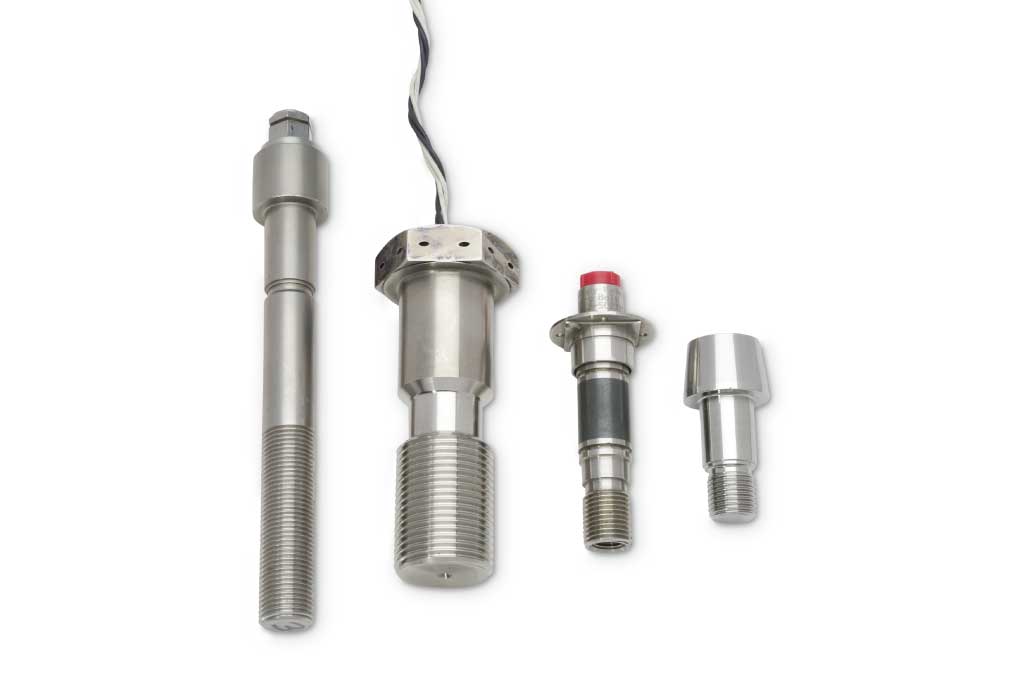
Explosive bolts are pyrotechnic fasteners designed for rapid structural separation in applications such as missiles, launch vehicles, and spacecraft, available in various sizes and tensile capacities.
Typed specifications11 values
Discloses 3 of 14 fields engineers filter by in this category (category median 1).
- Operating temperature
- -65 °C min · datasheet p.1 -3.1 °C max | -65–270 °C designs as low as -65 °F and up to +270 °F
- Separation type
- pyrotechnic explosive bolts, separation nuts and pyro bolts or studs · datasheet p.1
- Release command type
- pyro firing pulse input stimulus, typical: 3.5 amp (when electrically initiated… · datasheet p.1 current pulse when electrically initiated
- Command pulse duration
- 4.1 ms 4.5 AMP/4.1 millisecond (as printed: millisecond) · datasheet p.1
- Release current
- 3.5 A input stimulus, typical (when electrically initiated) · datasheet p.1 4.5 A 4.5 AMP/4.1 millisecond | 4.5 A for 4.1 millisecond
- Launch vehicles
- any launch vehicle datasheet p.1
Each value is typed with its unit and measurement condition and cites the datasheet page it was taken from. Nothing is guessed: a field that is absent here has not been published by the manufacturer. machine-extracted ✓ checked by NewSpace Market ✓ manufacturer confirmed by the manufacturer.
As published by the supplier12 lines, in the manufacturer's own wording
- Input stimulus, typical
- 3.5 amp (when electrically initiated)
- Input stimulus, typical (2)
- TLX or SMDC input
- Input stimulus, typical (3)
- 4.5 AMP/4.1 millisecond
- Tensile strength
- Up to 550,000 lbf
- Operating temperature
- Designs as low as -65 °F and up to +270 °F
- Separation time, typical
- <10 milliseconds after application of All-Fire input stimulus
- Separation time, typical (2)
- <5 milliseconds at greater currents
- Applicable specifications
- Qualified for: MIL-DTL-23659
- Applicable specifications (2)
- Mil-C-83124
- Input stimulus, typical (4)
- NASA NHB5300.4(1C)
- Input stimulus, typical (5)
- Mil-STD-1512
- Hermeticity (pre-function)
- Designs that comply with 1 x 10⁻⁶ cc He/sec at 1 atm
About
Explosive bolts, also known as pyrotechnic fasteners, are designed to efficiently secure two objects and then strategically explode on command to jettison those objects. They initiate a perfect failure at a pivotal moment, making them suitable for missile, launch vehicles, spacecraft, and marine applications where rapid structure separation is critical. These bolts are available in standard and ridge-cut configurations, offering a wide range of sizes, configurations, and tensile capacities from 200 pounds to 1,000,000 pounds. Key features include removability, low and controllable fragmentation, clean separation, immunity to vibration malfunction, high shock load resistance, and no moving parts prior to operation. The bolts work by using an explosive charge within a machined cavity (or externally for Piston Bolts) to provide the energetic stimulus for clean separation at a predetermined break plane. The design can control the separation location and breaking strength. There are two main types: explosive bolts (venting combustion gases) and separation bolts (containing combustion products). Standard explosive bolts use an explosive charge to exceed the bolt’s strength, while ridge-cut bolts employ shock wave mechanics to reflect the detonation shock wave, causing constructive interference that breaks the bolt with virtually no fragmentation and allowing for bolt expansion. Initiation can be electrical (typically 3.5 amps, tested up to 22 amps), via explosive transfer line (det cord, Rapid Deflagrating Cord, shock tube), or mechanical (lanyard or T-handle device). Redundancy options include dual bridge wires for electrical initiators, two separate initiators/detonators, or bolts with two inputs for a single break-plane, two independent break-planes, or two simultaneous break-planes. The bolts are supplied in a wide range of sizes and configurations tailored to structural loading, envelope, and environmental requirements, with tensile capacities ranging from 1400 pounds (.25 inch diameter) to 557,000 pounds (5.75 inches diameter).
Documentation
Need the full ICD, test reports or a specific revision? Ask the supplier directly.